
Sales teams spend too much time on tasks that do not close deals. Researching prospects, writing cold emails, logging calls, and updating forecasts eat hours that could go toward actual conversations. The best AI tools for sales teams in 2026 automate those layers without removing human judgment from the moments that matter.
In this guide, we compare the top AI sales tools across three core jobs: finding prospects, running outreach, and forecasting revenue. Every tool on this list is used by real sales teams today, with pricing and honest tradeoffs.
Key Takeaways
- Apollo.io leads on prospecting and contact data at an affordable price.
- Clay wins on data enrichment with its multi-source waterfall approach.
- Gong is the standard for conversation intelligence and deal coaching.
- Outreach and Salesloft dominate enterprise sales engagement.
- Clari gives leadership accurate revenue forecasting and pipeline visibility.
- Lavender improves individual rep performance through real-time email coaching.
What to Look for in an AI Sales Tool
Before buying, identify your team’s biggest bottleneck. Some teams struggle to find enough qualified leads. Others have leads but write weak outreach. Some lose deals because they cannot see pipeline risk early enough.
Here are the features that matter most:
- Prospecting and enrichment. The tool should find contacts, verify emails, and enrich profiles with job title, seniority, and intent signals.
- Outreach automation. It should sequence emails, calls, and LinkedIn touches with personalization that does not feel robotic.
- Conversation intelligence. It should record, transcribe, and analyze calls to surface coaching opportunities and deal risks.
- Forecasting accuracy. It should predict revenue outcomes based on real pipeline signals, not just rep optimism.
- CRM integration. Data should flow bidirectionally into Salesforce, HubSpot, or your system of record without manual entry.
Additionally, consider team size. Enterprise tools like Gong and Outreach require annual contracts and implementation support. Smaller teams may get more value from lighter, self-serve platforms.
The Top 6 AI Sales Tools Compared
1. Apollo.io — Best for Prospecting and Sequencing
Apollo.io combines a massive contact database with built-in email sequencing. It gives sales teams access to over 210 million contacts and 35 million companies, filtered by job title, seniority, industry, and intent signals.
Why it stands out:
- One platform for finding contacts, enriching data, and running outreach sequences.
- Built-in email verification reduces bounce rates before campaigns launch.
- Bi-directional CRM sync with Salesforce and HubSpot keeps records current.
- AI-powered persona messaging suggests outreach angles based on role and industry.
Pricing: Free tier available. Paid plans start at $49 per user per month (annual billing). Professional at $79 per user per month. Organization at $119 per user per month with a 3-user minimum.
Best for: Mid-market B2B teams that need an all-in-one prospecting and outreach engine without enterprise pricing.
Privacy note: Apollo processes contact data in the cloud. Ensure your data processing agreements cover third-party enrichment services before uploading sensitive account lists.
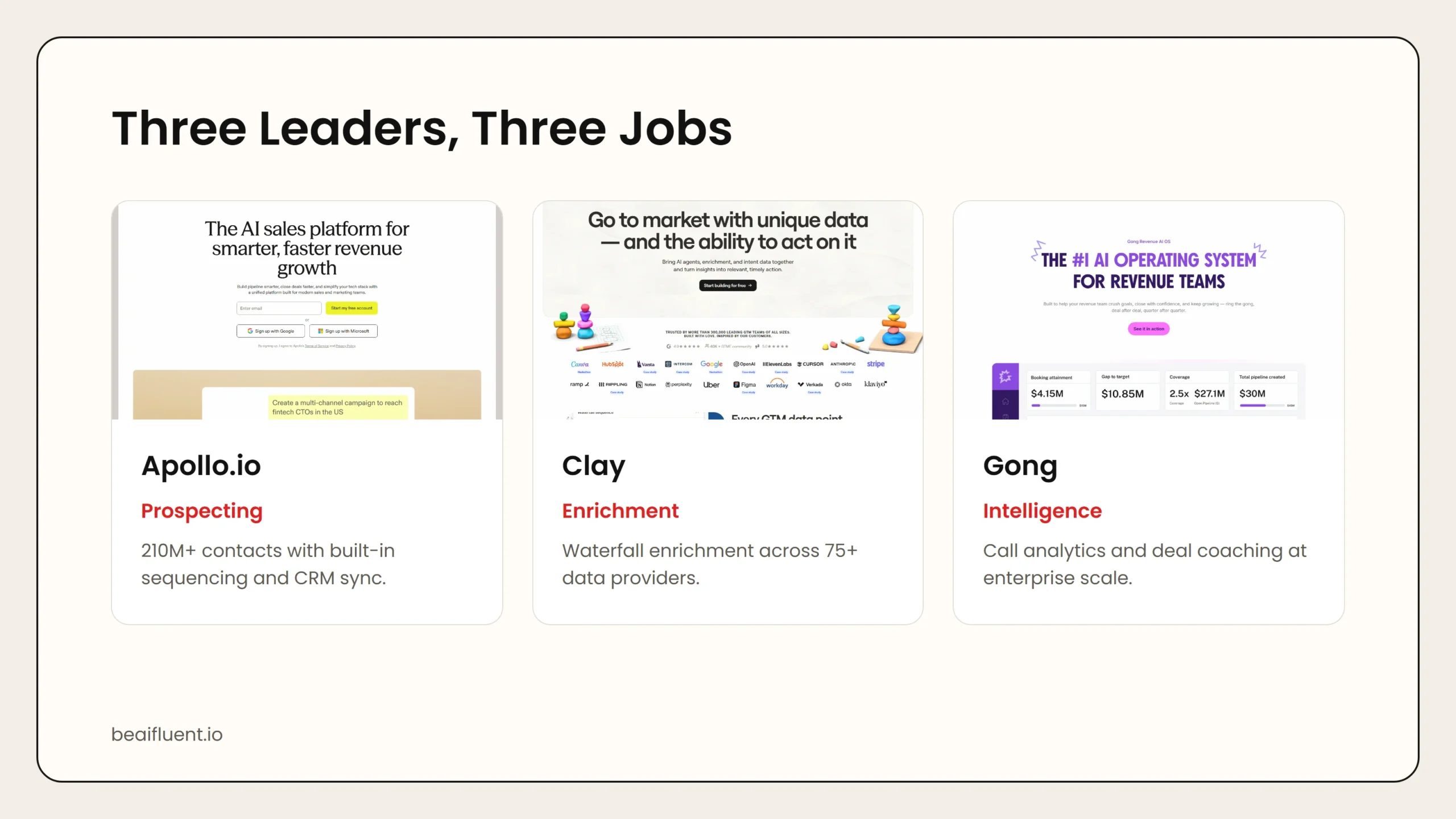 Caption: Apollo.io leads on affordable prospecting. Clay wins on enrichment quality. Gong dominates conversation intelligence and deal coaching.
2. Clay — Best for Data Enrichment and Personalization
Clay takes a different approach to prospecting. Instead of relying on one database, it queries over 75 data providers in sequence through a technique called waterfall enrichment. If Provider A lacks data on a contact, Provider B tries next. This produces higher match rates than any single source.
Why it stands out:
- Waterfall enrichment across 75+ data providers improves match rates.
- Claymation AI agent automates research and writes personalized outreach lines.
- No charge for failed lookups, so you only pay for successful enrichment.
- Data costs dropped 50–90% after the March 2026 pricing overhaul.
Pricing: Launch plan at $185 per month. Growth plan at $495 per month. Enterprise custom.
Best for: Teams that need high-quality enrichment and custom research workflows, especially those running account-based outreach at scale.
Privacy note: Clay passes contact data through multiple external providers. Review your data processing agreements and confirm each provider meets your compliance standards.
3. Gong — Best for Conversation Intelligence and Coaching
Gong records and analyzes sales calls to extract insights that managers would otherwise miss. It tracks talk-to-listen ratios, competitor mentions, deal risks, and coaching opportunities. The platform has become the default conversation intelligence tool for mid-market and enterprise sales teams.
Why it stands out:
- AI deal boards predict which opportunities are at risk based on call signals.
- Coaching scorecards show exactly what top performers do differently.
- Keyword and topic tracking reveal competitor mentions and objection patterns.
- Integrates with major CRMs, dialers, and video conferencing platforms.
Pricing: Custom pricing with platform fees ranging from $5,000 to $50,000 per year plus $120 to $250 per user per month. First-year costs for mid-sized teams often exceed $100,000.
Best for: Sales teams with 10+ reps that want to improve win rates through data-driven coaching and deal visibility.
Privacy note: Gong records and transcribes calls. Notify all participants before recording, and confirm compliance with call-recording laws in your jurisdiction.
4. Outreach — Best for Enterprise Sales Engagement
Outreach is a sales engagement platform built for large teams running complex, multi-touch sequences. It orchestrates email, phone, LinkedIn, and SMS touches while giving managers visibility into rep activity and sequence performance.
Why it stands out:
- Multi-channel sequences across email, phone, LinkedIn, and SMS.
- Kaia real-time call coaching assists reps during live conversations.
- Advanced analytics show which sequence steps drive replies and meetings.
- Deep Salesforce integration with custom field mapping and automated logging.
Pricing: Custom enterprise pricing, typically $100 to $160 per user per month with annual contracts.
Best for: Enterprise sales teams with dedicated SDRs and account executives who need structured, scalable outreach execution.
Privacy note: Outreach stores prospect data and engagement history in the cloud. Confirm data residency and retention policies align with your compliance requirements.
5. Clari — Best for Revenue Forecasting
Clari focuses on the bottom of the funnel. It analyzes pipeline data to predict revenue outcomes, identify deal risks, and give leadership real-time visibility into quarter performance. While Gong coaches reps, Clari coaches the forecast.
Why it stands out:
- AI-powered forecast confidence scores replace spreadsheet guesswork.
- Pipeline inspection shows deal health without relying on rep self-reporting.
- Predictive analytics flag deals at risk before they slip.
- Mobile apps keep leadership informed outside the office.
Pricing: Custom pricing, typically $60 to $200 per user per month. Add-ons like Copilot and Groove increase costs significantly.
Best for: Revenue operations teams, sales leadership, and CFOs who need accurate forecasting and pipeline visibility.
Privacy note: Clari syncs deeply with CRM data. Ensure your Salesforce or HubSpot security settings allow third-party analytics access.
6. Lavender — Best for Email Coaching
Lavender is not a CRM or a sequencing platform. It is a real-time email coach that scores outbound messages on a 1–100 scale and suggests improvements based on length, tone, reading level, and question placement.
Why it stands out:
- Real-time email scoring inside Gmail and Outlook.
- Prospect personality profiling from LinkedIn data.
- Communication style matching adapts tone to the recipient.
- Users report significant reply rate improvements after adoption.
Pricing: Free tier for 5 emails per month. Starter at $29 per month. Pro at $49 per month. Teams at $69 per user per month.
Best for: Individual reps and teams who rely heavily on cold email and want to improve message quality without hiring a copywriter.
Privacy note: Lavender analyzes email content and LinkedIn profiles through a browser extension. Review what data the extension accesses before rolling out to the full team.
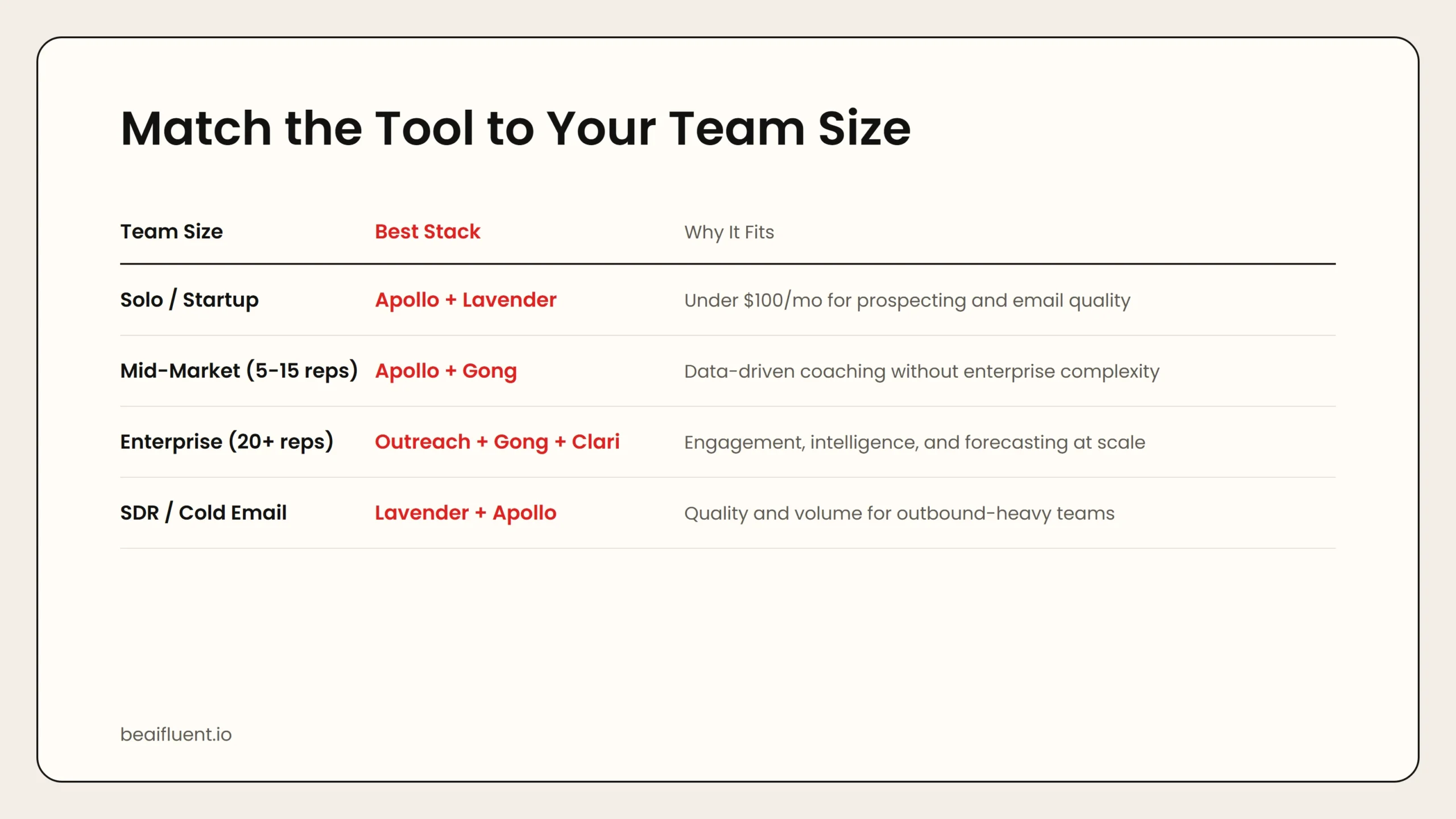 Caption: Startups use Apollo and Lavender. Mid-market adds Gong. Enterprise stacks Outreach, Gong, and Clari.
Side-by-Side Comparison
| Tool | Free Tier | Starting Price | Best For | Core Strength |
|---|---|---|---|---|
| Apollo.io | Yes | $49/user/mo | Prospecting + outreach | All-in-one lead database |
| Clay | No | $185/mo | Enrichment + personalization | 75-provider waterfall |
| Gong | No | Custom (~$120–250/user/mo) | Call coaching + deal intel | Conversation analytics |
| Outreach | No | Custom (~$100–160/user/mo) | Enterprise engagement | Multi-channel sequences |
| Clari | No | Custom (~$60–200/user/mo) | Forecasting + pipeline | Revenue prediction |
| Lavender | Yes (5 emails/mo) | $29/mo | Email quality | Real-time scoring |
Use this table to narrow your search. If budget is tight, start with Apollo.io and Lavender. If you manage a large team, Gong and Outreach are safer enterprise bets.
How to Choose the Right Tool for Your Team
Different sales teams need different stacks. Here is a quick matching guide:
- Solo founder or early-stage startup → Apollo.io free tier + Lavender. Covers prospecting and email quality for under $100 per month.
- Mid-market team with 5–15 reps → Apollo.io or Clay for prospecting, Gong for call coaching, and your existing CRM for management.
- Enterprise team with 20+ reps → Outreach for engagement, Gong for intelligence, Clari for forecasting. Budget $1,000–$1,500 per rep per month for the full stack.
- SDR team focused on cold email → Lavender + Apollo.io sequences. This pairing improves both message quality and volume.
- Account-based sales team → Clay for deep enrichment, Outreach for structured sequences, Gong for deal coaching.
Tip: Do not buy a full stack on day one. Start with the tool that solves your biggest bottleneck. Prove ROI for 60 days, then add the next layer.
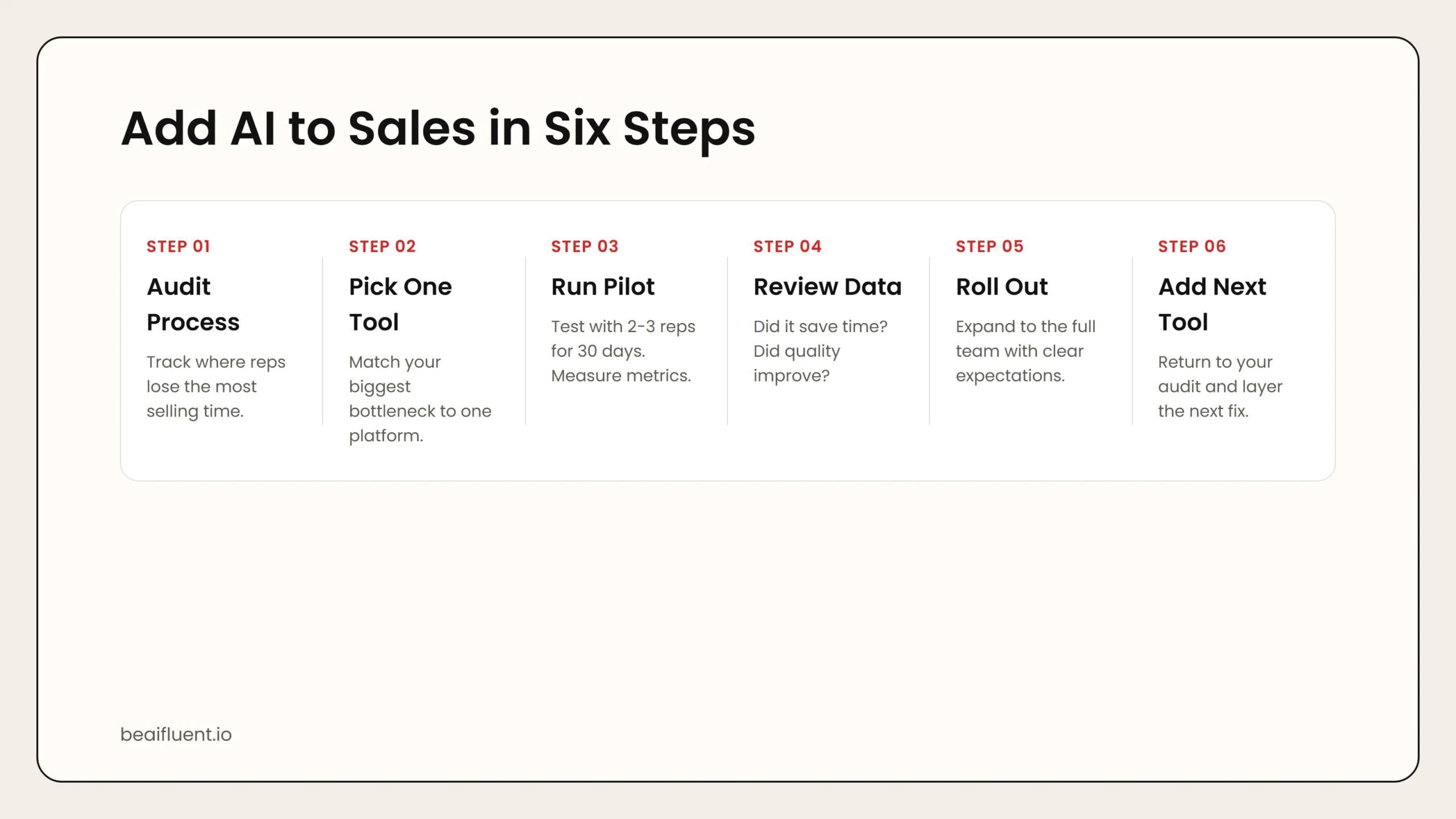 Caption: Audit your process, pick one tool, run a pilot, review data, roll out, then add the next layer.
A Simple Workflow for Adding AI to Your Sales Process
Follow these steps to introduce AI sales tools without overwhelming your team:
- Audit your current process. Track where reps spend the most non-selling time. Common culprits are prospect research, email drafting, and call logging.
- Pick one bottleneck. Choose the single biggest time sink and match it to one tool from this guide.
- Run a 30-day pilot. Give 2–3 reps access and measure before-and-after metrics like emails sent, reply rates, or calls logged.
- Review the data. Did the tool save time? Did it improve outcomes? Gather honest feedback from the pilot team.
- Roll out to the full team. If the pilot succeeds, expand access and set clear usage expectations.
- Add the next tool. Once the first tool is adopted, return to your audit and pick the next bottleneck.
Warning: AI sales tools automate tasks but they do not replace judgment. A poorly written AI email sent to 1,000 prospects will damage your brand faster than manual outreach. Always review templates and monitor output quality.
Common Mistakes to Avoid
Even with great tools, teams can underperform. Avoid these pitfalls:
- Buying before diagnosing. Do not purchase Gong if your real problem is that reps cannot find enough leads to call.
- Ignoring adoption. A tool that reps refuse to use is wasted budget. Choose tools with interfaces your team will actually enjoy.
- Over-automating outreach. Prospects can spot generic AI personalization. Use AI to research, but let humans craft the final message.
- Neglecting data hygiene. AI tools are only as good as the CRM data they read. Clean your records before adding intelligence layers.
- Skipping compliance review. Call recording, email scraping, and data enrichment all carry legal risks. Confirm compliance before scaling.
Frequently Asked Questions
What is the best AI sales tool for small teams?
Apollo.io offers the best balance of features and price for small teams. The free tier covers basic prospecting, and paid plans start at $49 per user per month.
Can AI sales tools replace SDRs?
Partially. AI SDR tools like 11x.ai and Artisan can handle list building, enrichment, and initial outreach. However, complex objections, relationship building, and strategic account planning still require humans.
How much should a sales team budget for AI tools?
Small teams can start for under $300 per month. Mid-market teams typically spend $5,000–$8,000 per month. Enterprise teams may invest $20,000–$50,000 per month across the full stack.
Do AI sales tools integrate with Salesforce and HubSpot?
Yes. Apollo.io, Gong, Outreach, and Clari all offer deep integrations with both Salesforce and HubSpot. Always verify the specific data sync direction during your trial.
Is AI-generated outreach legal?
Yes, but regulations vary by region. The EU AI Act classifies certain hiring and outreach AI as high-risk. In the US, comply with CAN-SPAM for email and TCPA for SMS. Always disclose AI use where required by law.
Sources
- Apollo.io pricing and features
- Clay pricing and features
- Gong pricing and features
- Outreach pricing and features
- Clari pricing and features
- Lavender pricing and features
If you are building a broader AI toolkit for your business, our guide to the top AI tools for marketing professionals pairs naturally with your sales stack. For teams just getting started with AI, how to start using AI as a complete beginner covers safe first steps.