
What Is AI Fluency and Why It Matters
AI fluency is the ability to use AI tools effectively, evaluate their output critically, and apply them responsibly in everyday work. It is not about building models or writing code. It is about knowing when AI helps, when it does not, and how to get better results from the tools that already exist.
This matters because AI is no longer a specialist technology. Professionals across every industry are using AI tools for writing, research, planning, analysis, and communication. The people who struggle are not the ones who lack access. They are the ones who do not know how to use these tools well enough to trust the results.
This article explains what AI fluency means in practical terms, why it matters more than surface-level AI awareness, and how to start building the skills that make AI genuinely useful for real work.
Key Takeaways
- AI fluency means knowing how to use AI tools well, not just knowing they exist.
- It includes prompting, output review, workflow design, tool selection, and responsible use.
- AI fluency is different from AI literacy, which focuses more on understanding concepts than applying them.
- The professionals who benefit most are the ones who treat AI as a skill to practice, not a feature to activate.
- You do not need a technical background to build AI fluency. You need consistent practice with real tasks.
Table of Contents
- What Does AI Fluency Actually Mean?
- Why AI Fluency Matters Now
- AI Fluency vs AI Literacy
- The Five Core Skills of AI Fluency
- What AI Fluency Looks Like in Practice
- Who Needs AI Fluency?
- How to Start Building AI Fluency
- Common Misconceptions
- FAQ
What Does AI Fluency Actually Mean?
AI fluency is a working skill, not a credential. A person who is fluent in AI can sit down with a tool like ChatGPT, Claude, Gemini, or Copilot and get a useful result — not because they memorized a list of prompt tricks, but because they understand what the tool is good at, what it is likely to get wrong, and how to shape the interaction.
Think of it like language fluency. You can memorize vocabulary lists and still struggle to hold a conversation. Real fluency means being able to think and work in the language, adapt when something is unclear, and know when the translation is off.
AI fluency works the same way. It is the difference between copying a prompt from the internet and knowing how to write one that fits your actual task. It is the difference between accepting an AI draft at face value and knowing which parts to verify before you use it.
At its core, AI fluency combines five things:
- Prompting skill — the ability to write clear, specific, and effective instructions for AI tools.
- Output evaluation — the ability to review what an AI produces and judge whether it is accurate, useful, and complete.
- Tool awareness — knowing which tools exist, what each one does well, and when to switch between them.
- Workflow integration — the ability to fit AI into a repeatable work process rather than using it as a one-off novelty.
- Responsible use — understanding the ethical, privacy, and quality boundaries of AI tools and staying within them.
None of these require you to understand how a language model works under the hood. They require practice, attention, and judgment.
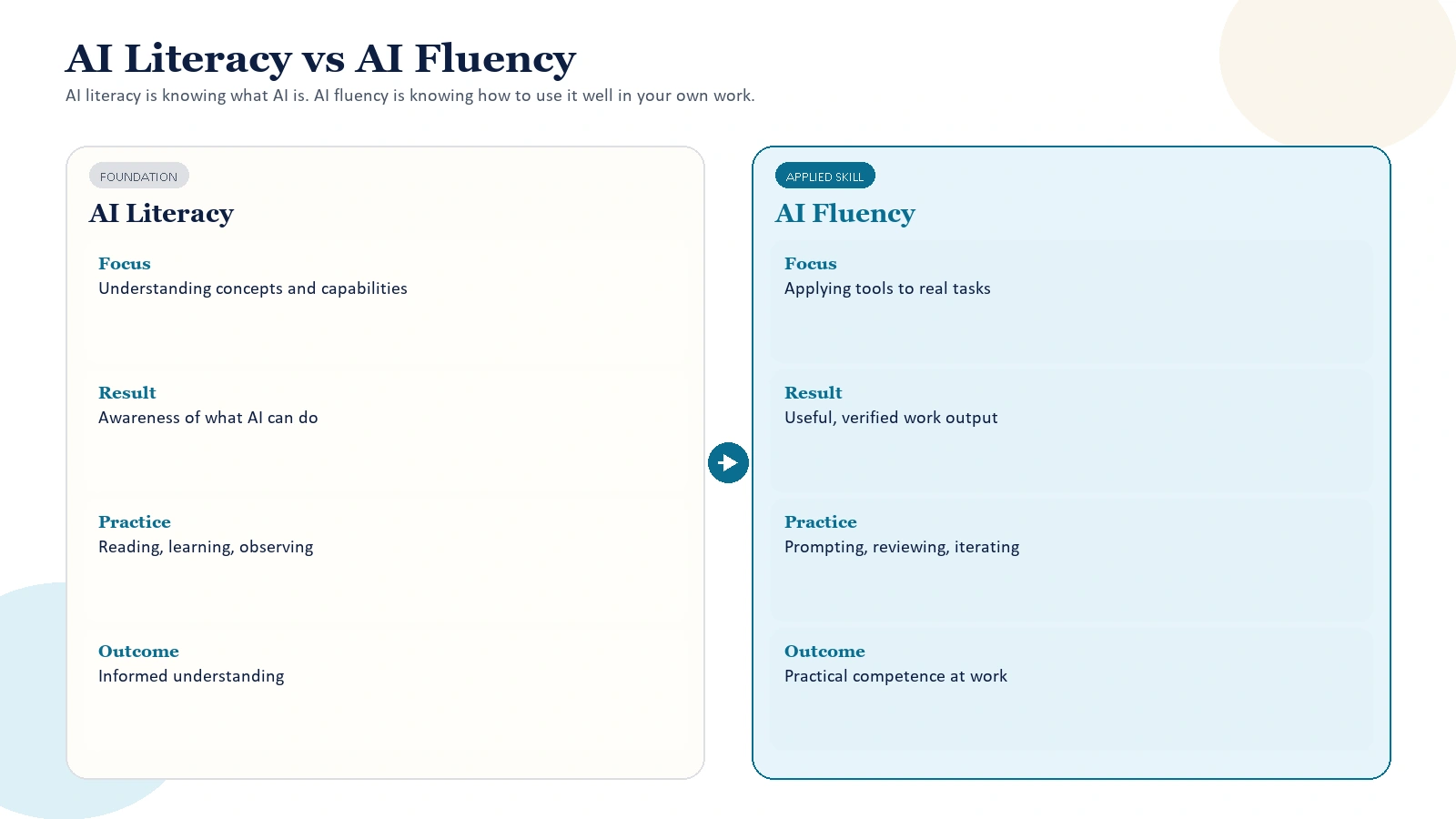
Caption: AI literacy is knowing what AI is. AI fluency is knowing how to use it well in your own work.
Why AI Fluency Matters Now
Three things changed in the last two years that make AI fluency a practical career skill rather than a nice-to-have.
AI tools became accessible. In 2024, free and low-cost AI tools reached a level of quality where non-technical people could use them for real work. By 2026, the baseline has risen further. The barrier is no longer access. It is skill.
Employers started expecting it. According to a 2024 Microsoft and LinkedIn Work Trend Index report, 75% of knowledge workers were already using AI at work, and 66% of leaders said they would not hire someone who lacked AI skills. Whether or not every job posting says “AI fluency required,” the expectation is forming.
The gap between users and fluent users widened. Most people who use AI tools today are still in the “copy a prompt, accept the output” stage. That works for casual use. It does not work when the task is high-stakes, when the output needs to be accurate, or when the workflow needs to scale. The people who can do more — who can evaluate, iterate, integrate, and verify — have a real advantage.
AI fluency is not a future skill. It is a current one. The question is not whether you will need it, but how far behind you are if you do not start building it now.
AI Fluency vs AI Literacy
These two terms are often used interchangeably, but they describe different levels of capability.
AI literacy means understanding what AI is, how it works at a high level, and what it can and cannot do. It is the foundation. A person with AI literacy can explain what a language model is, understand why AI sometimes generates incorrect information, and recognize when AI is being used in a product they interact with.
AI fluency goes further. It means being able to use AI tools effectively in your own work, evaluate outputs critically, build workflows, and make responsible decisions about when and how to apply AI.
The distinction matters because literacy alone does not produce results. A person who understands that AI can hallucinate but does not know how to verify an AI-generated claim has literacy without fluency. A person who can write a prompt, check the output against reliable sources, refine the result, and embed it into a useful workflow has fluency.
Think of it this way:
- AI literacy: knowing that AI tools exist and understanding their general strengths and limits.
- AI fluency: being able to use those tools to produce, evaluate, and integrate work that meets a real standard.
Both matter. But fluency is what creates practical value.
The Five Core Skills of AI Fluency
AI fluency is not one ability. It is a set of skills that work together. Here is what each one means in practice.
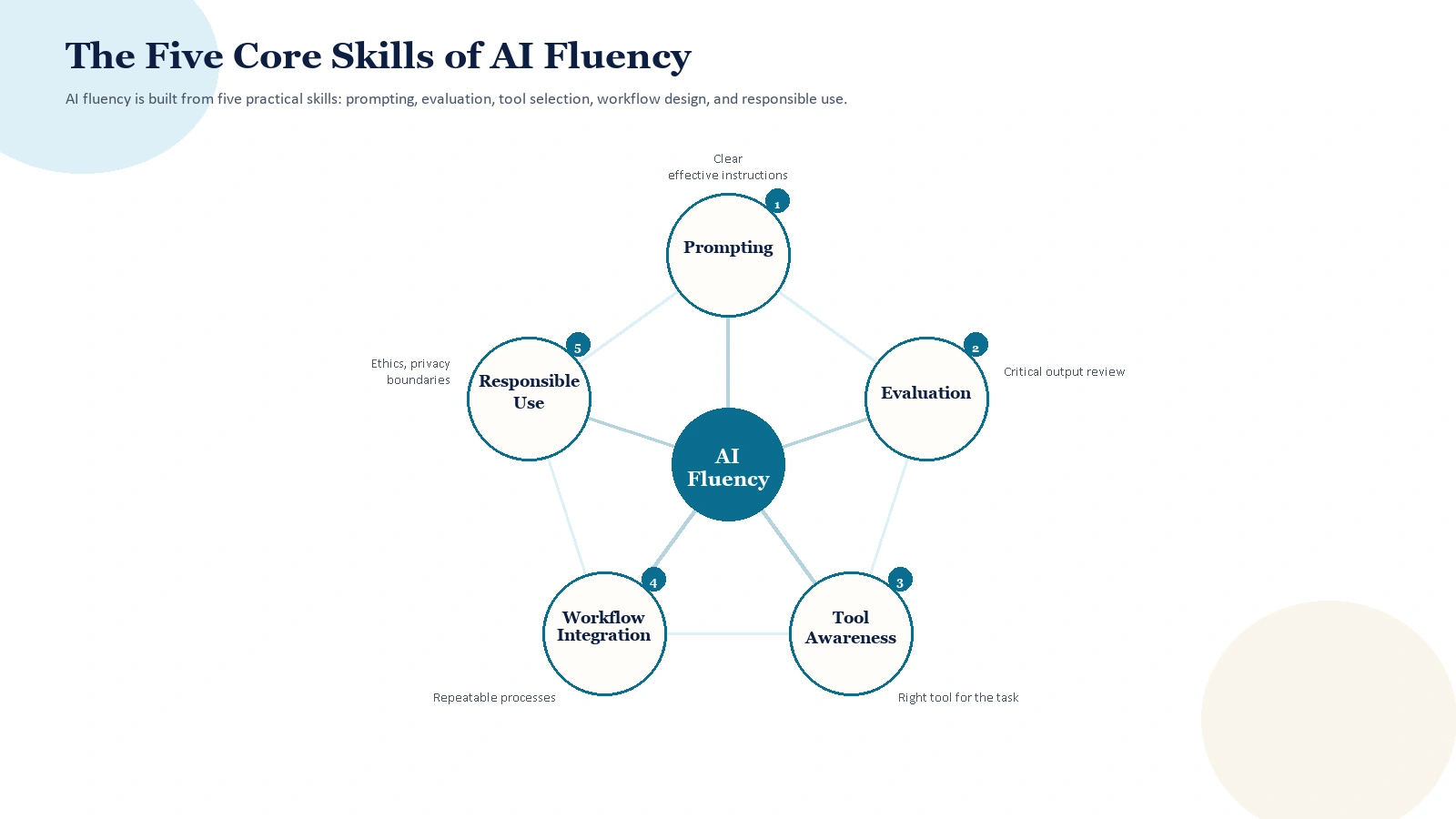
Caption: AI fluency is built from five practical skills: prompting, evaluation, tool selection, workflow design, and responsible use.
1. Prompting
Prompting is the skill of giving AI tools clear, well-structured instructions. It is the most visible part of AI fluency, but it is not the whole thing.
Good prompting means:
- defining the task clearly
- setting constraints like format, length, audience, and tone
- providing enough context for the tool to produce useful output
- iterating when the first result is not good enough
Bad prompting means:
- vague one-line requests
- expecting the tool to read your mind
- never refining or redirecting the output
Prompting improves with practice. The fastest way to get better is to use AI tools regularly for work you already know how to evaluate.
2. Output Evaluation
This is the most underrated part of AI fluency. AI tools produce confident-sounding text, code, plans, and summaries — whether or not the content is accurate.
Output evaluation means:
- reading the full result before using it
- checking facts against reliable sources
- recognizing when the output is vague, overly generic, or structurally weak
- knowing when to reject a draft and start over
Without this skill, AI fluency is just fast typing with extra risk.
3. Tool Awareness
Not every AI tool does the same thing. A person with strong tool awareness knows:
- which tools are best for writing, research, data analysis, coding, or creative work
- when a free tool is enough and when a paid tool is worth it
- when to switch tools instead of fighting the wrong one
Tool awareness also means keeping up with changes. AI tools evolve quickly. A tool that was limited six months ago may now be significantly more capable.
4. Workflow Integration
The difference between someone who uses AI occasionally and someone who is AI fluent is often workflow integration. This means:
- embedding AI into a repeatable process rather than using it ad hoc
- combining AI steps with human review steps
- building templates or systems that make the process faster over time
For example, a professional who uses AI to summarize weekly meeting notes, then reviews and edits the summary before sharing it, has a simple but effective workflow. That is more valuable than using AI once for a random task.
5. Responsible Use
AI fluency includes knowing the boundaries. That means:
- not feeding sensitive or private data into tools that do not protect it
- understanding that AI output can contain bias, errors, or fabricated information
- being transparent about when and how AI was used in your work
- knowing when not to use AI at all
Responsible use is not an add-on. It is part of being genuinely fluent.
What AI Fluency Looks Like in Practice
AI fluency shows up in small, daily decisions more than in dramatic demonstrations.
A marketer uses AI to draft social media posts, but always reviews the copy for tone, accuracy, and brand alignment before scheduling. They use a saved prompt template so the process takes minutes instead of starting from scratch each time.
An analyst uses AI to summarize long reports, then cross-checks the key claims against the original data before sharing the summary with stakeholders.
A student uses AI to brainstorm outline ideas for an essay, then writes the essay themselves using the outline as a starting point. They cite real sources and use the AI output as a thinking tool, not a finished product.
A team lead uses AI to turn scattered meeting notes into a structured action list, then reviews and assigns the items manually. Over time, they build a recurring workflow that runs weekly with minimal setup.
In every case, the AI did not replace the person’s judgment. It compressed one part of the work. The person stayed in control of quality, accuracy, and decision-making.
Who Needs AI Fluency?
The short answer is: anyone whose work involves writing, research, planning, analysis, communication, or decision-making.
More specifically:
- Professionals in non-technical roles who want to work faster without sacrificing quality.
- Students and self-learners who want to build modern skills that employers value.
- Career switchers who need to demonstrate practical digital competence.
- Managers and team leads who want to understand what AI can do for their teams.
- Founders and solo operators who need more leverage from fewer resources.
AI fluency is less about which role you hold and more about whether your work involves decisions, content, or information. If it does, fluency will help.
How to Start Building AI Fluency
AI fluency is built through consistent practice with real tasks. Here is a practical starting path.
Step 1. Pick one AI tool and use it for real work. Start with a general-purpose tool like ChatGPT, Claude, or Gemini. Use it for a task you already do, such as drafting an email, summarizing a document, or outlining a plan. Do not start with the hardest problem you have. Start with something you can evaluate yourself.
Step 2. Learn to review before you trust. Read the full output every time. Check any factual claim against a reliable source. Notice when the tone is wrong, the structure is off, or the content is vague. This is the habit that separates fluent users from casual ones.
Step 3. Build one repeatable workflow. Turn your best prompt into a saved template. Combine it with a review step and a clear output format. Repeat it at least five times. That turns a one-off experiment into a usable system.
Step 4. Expand your tool awareness. Once your first workflow is stable, explore whether a different tool does it better. Try comparing outputs across tools for the same task. Learn what each tool is strong and weak at. The range spans from simple chat interfaces to more specialized options like AI CLIs, but begin with whatever feels approachable.
Step 5. Practice responsible use. Before using AI for anything sensitive, check the tool’s privacy policy. Understand what data is stored and what is not. Be transparent with colleagues about when AI was involved in your work.
This path works because it starts from action, not theory. You learn AI fluency the same way you learn any working skill: by doing it, reviewing the results, and improving over time.
Common Misconceptions
“AI fluency means you are good at prompting.”
Prompting is one part of it. But AI fluency also includes output review, tool selection, workflow design, and responsible use. A great prompt with no review step is a liability.
“You need a technical background.”
No. AI fluency is a practical skill for non-technical professionals. You do not need to understand how neural networks work to use AI well. You need to understand how to evaluate, refine, and integrate AI output into your work.
“AI fluency is just for young workers.”
AI tools are role-agnostic and age-agnostic. Anyone who works with information, content, or communication can benefit. The barrier is not demographics. It is willingness to practice.
“If you use AI every day, you are already fluent.”
Frequency is not fluency. Using AI every day without reviewing the output, improving your prompts, or building workflows is just fast repetition. Fluency means the quality of the interaction improves over time.
FAQ
What is AI fluency in simple terms?
AI fluency is the ability to use AI tools effectively for real work. It includes writing good prompts, evaluating AI output, choosing the right tools, building repeatable workflows, and using AI responsibly. It is a practical working skill, not a technical credential.
Is AI fluency the same as AI literacy?
No. AI literacy means understanding what AI is and what it can do. AI fluency means being able to use AI tools to produce, evaluate, and integrate real work. Literacy is the foundation. Fluency is the applied skill.
Do I need to learn to code to become AI fluent?
No. AI fluency does not require coding. It requires practice with AI tools, critical evaluation of their output, and the ability to fit them into your workflows. Some tools are designed for more technical users, but most AI fluency skills apply to general-purpose tools that anyone can use.
How long does it take to build AI fluency?
There is no fixed timeline, but most people can build a functional level of fluency within 30 days of regular practice. The key is consistent use with real tasks, not passive reading or watching tutorials.
Why does AI fluency matter for my career?
Because employers increasingly expect it. AI tools are becoming standard in most knowledge work. The professionals who can use them well — and who can verify, iterate, and integrate — will be more productive, more employable, and more adaptable as the tools continue to change.
Conclusion
AI fluency is the practical skill of using AI tools well enough to trust the results. It is not about understanding machine learning theory or memorizing prompt formulas. It is about building the judgment, habits, and workflows that make AI genuinely useful for your work.
What is AI fluency? It is what happens when you stop treating AI as a novelty and start treating it as a tool you are learning to use with skill, care, and purpose. The people who build that fluency now will have a meaningful advantage — not because AI does their work for them, but because they know how to work with AI better than most.
Start with one tool, one task, and one review step. Build from there.
Suggested Internal Link Opportunities
- /blog/ai-literacy-vs-ai-fluency (future — companion article covering the distinction in depth)
- /blog/how-to-write-better-ai-prompts (future — prompting skills gateway)
- /blog/how-to-review-ai-output-before-you-trust-it (future — verification anchor)
- /blog/how-to-start-using-ai-as-a-complete-beginner (future — Day 1 companion for beginners)
- /blog/how-ai-fluency-improves-career-readiness (future — career cluster link)
- /blog/how-to-build-ai-skills-in-30-days (future — practical 30-day plan)
Sources
- 2024 Work Trend Index: AI at Work Is Here. Now Comes the Hard Part. — Microsoft and LinkedIn
- OECD Skills Outlook 2023: Skills for a Resilient Green and Digital Transition — OECD
- The state of AI in early 2024 — McKinsey