
Writing great content is only half the battle. If search engines cannot understand your article, readers will never find it. The best AI SEO tools in 2026 bridge that gap. They help you find the right keywords, optimize your structure, and outrank competitors without spending years learning technical SEO.
In this guide, we compare the top AI SEO tools for content creators. We cover what each tool does best, how much it costs, and which one fits your publishing workflow.
What to Look for in an AI SEO Tool
Before choosing a tool, understand your biggest SEO bottleneck. Some creators struggle with keyword research. Others write well but miss on-page optimization. Here are the features that matter most:
- Keyword research. The tool should suggest relevant keywords with search volume, difficulty, and intent data.
- Content optimization. It should score your draft against top-ranking pages and suggest improvements.
- Competitor analysis. You should see what headings, keywords, and structure competitors use.
- SERP analysis. The tool should explain what Google actually shows for your target query.
- Readability scoring. Good SEO content must also be readable for humans.
Additionally, consider integration. Some tools work inside Google Docs or WordPress. Others require you to copy and paste between apps.
The Top 5 AI SEO Tools Compared
1. Surfer SEO — Best for Content Optimization
Surfer SEO analyzes the top-ranking pages for your keyword and tells you exactly how to match their structure. It suggests word count, headings, images, and specific terms to include. The Content Editor gives you a real-time optimization score as you write.
Why it stands out:
- Real-time content score based on top SERP competitors.
- Suggests exact keywords, headings, and paragraph counts.
- Integrates with Google Docs, Jasper, and WordPress.
- Grow Flow feature suggests weekly content opportunities.
Pricing: Plans start around $69 per month. The Essential plan covers most solo creators. Agencies need higher tiers for more content editors.
Best for: Bloggers, content agencies, and SEO-focused writers who want data-driven optimization.
Privacy note: Surfer SEO analyzes your content on cloud servers. Do not paste sensitive client drafts unless your contract allows it.
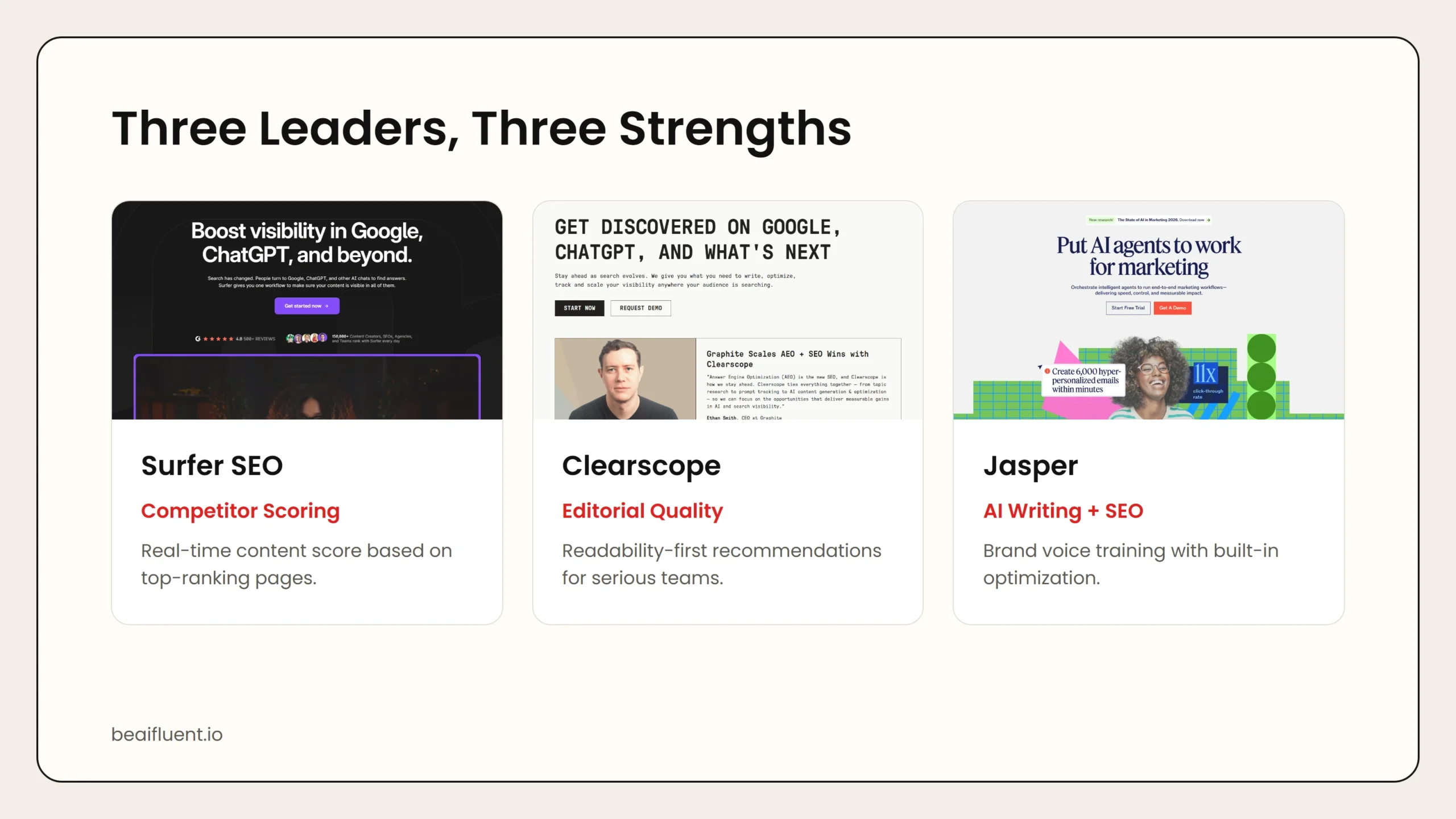 Caption: Surfer SEO leads on real-time competitor scoring. Clearscope wins on editorial quality. Jasper combines AI writing with SEO structure.
2. Clearscope — Best for Enterprise and Quality Control
Clearscope is the premium choice for teams that prioritize content quality. It grades your article against top competitors and suggests terms, readability targets, and content depth. The interface is cleaner than Surfer SEO, and the recommendations feel less mechanical.
Why it stands out:
- Clean, distraction-free content editor.
- Strong emphasis on readability and relevance, not just keyword density.
- Excellent reporting for editorial teams.
- Integrates with Google Docs and WordPress.
Pricing: Clearscope starts around $189 per month. It is more expensive than Surfer SEO, but the quality of recommendations justifies the price for serious teams.
Best for: Editorial teams, content agencies, and brands with high publishing standards.
Privacy note: Clearscope processes content through cloud servers. Enterprise plans offer stronger data handling agreements.
3. Jasper — Best for AI Writing + SEO Combined
Jasper started as an AI writing assistant. After adding SEO mode, it became a viable all-in-one tool. You can research keywords, generate drafts, and optimize content without leaving the app. Jasper integrates with Surfer SEO for deeper optimization scores.
Why it stands out:
- AI-generated first drafts with SEO structure built in.
- Brand voice training keeps output consistent.
- Surfer SEO integration adds competitor analysis.
- Templates for ads, emails, and social posts expand beyond blog SEO.
Pricing: Plans start around $49 per month. Higher tiers unlock SEO mode, brand voices, and team collaboration.
Best for: Solo creators and small teams who want writing and SEO in one tool.
Privacy note: Jasper trains models on user interactions. Review their data policy if you write about sensitive industries.
4. Semrush Writing Assistant — Best for Keyword Research Integration
Semrush is already a powerhouse for keyword research and competitor analysis. The Writing Assistant brings that data directly into your draft. It scores your content for readability, originality, SEO, and tone of voice. Because it connects to Semrush’s massive keyword database, the suggestions are deeply informed.
Why it stands out:
- Direct connection to Semrush keyword and backlink data.
- Scores readability, SEO, originality, and tone in one dashboard.
- Works inside Google Docs, WordPress, and Microsoft Word.
- Competitive density metrics show how hard ranking will be.
Pricing: The Writing Assistant is included with Semrush subscriptions, which start around $139 per month. This makes it expensive if you only need writing help, but excellent if you already use Semrush for research.
Best for: Marketers and SEO professionals who already rely on Semrush for keyword and competitor data.
Privacy note: Semrush stores your content for analysis. Enterprise accounts have stronger data controls.
5. RankIQ — Best for Bloggers on a Budget
RankIQ is built specifically for bloggers. It identifies low-competition keywords in your niche and provides an optimization checklist for each post. Unlike Surfer SEO, which targets SEO professionals, RankIQ speaks the language of content creators who want simple, actionable advice.
Why it stands out:
- Hand-picked low-competition keyword library.
- Simple optimization checklist for every post.
- No steep learning curve. Designed for non-SEO experts.
- Affordable pricing for solo bloggers.
Pricing: RankIQ starts around $49 per month. The value is excellent for bloggers who publish consistently and need keyword direction.
Best for: Niche bloggers, affiliate marketers, and solo creators who want guided SEO without complexity.
Privacy note: RankIQ analyzes content through standard cloud processing. No special enterprise privacy tier is offered.
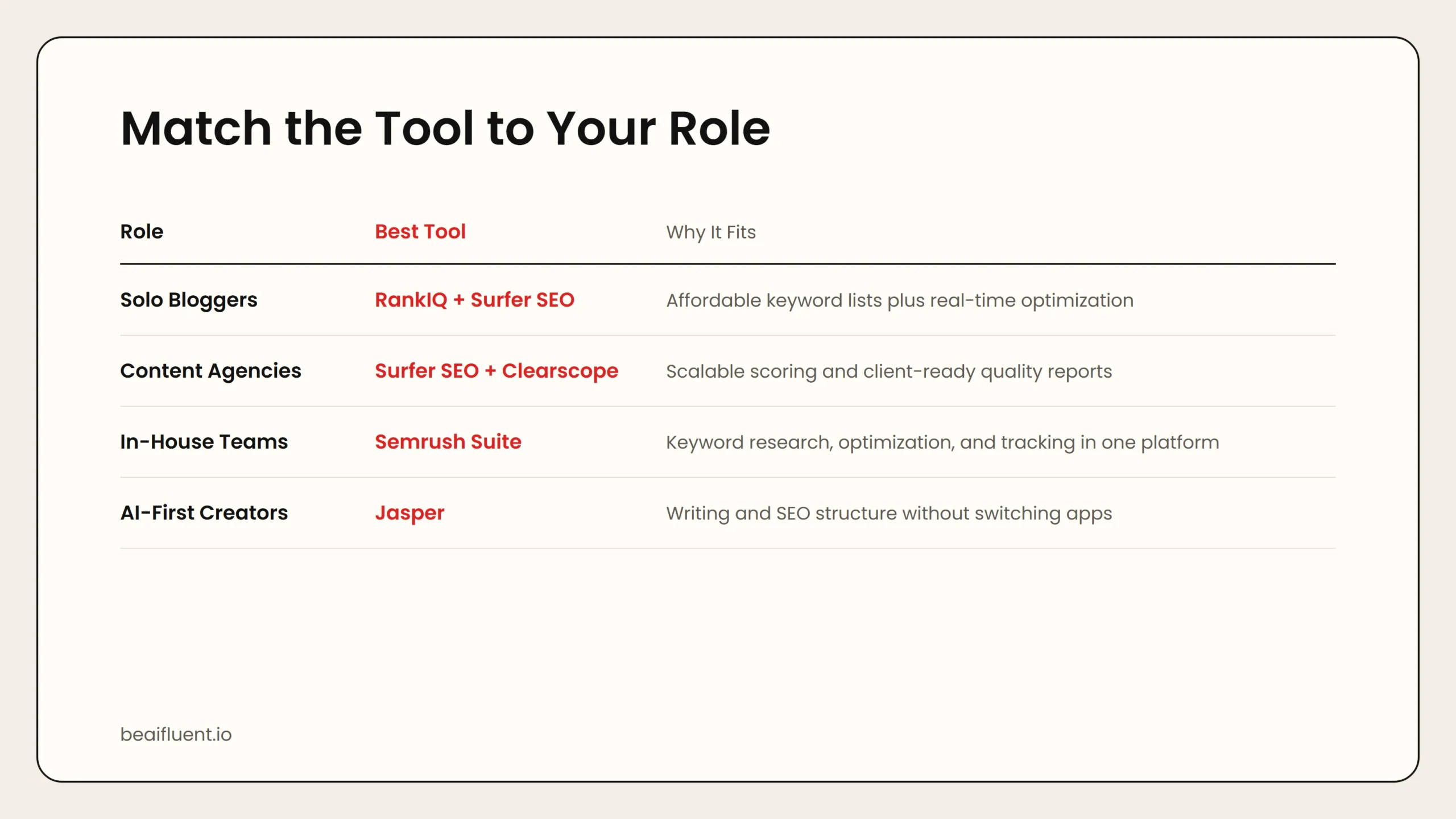 Caption: Solo bloggers start with RankIQ. Content agencies need Surfer SEO or Clearscope. In-house teams benefit from Semrush integration.
Side-by-Side Comparison
| Tool | Best For | Top Feature | Starting Price | Free Trial |
|---|---|---|---|---|
| Surfer SEO | Data-driven optimization | Real-time content score vs competitors | ~$69/mo | Yes |
| Clearscope | Editorial quality | Readability-first recommendations | ~$189/mo | Yes |
| Jasper | AI writing + SEO | Brand voice + Surfer integration | ~$49/mo | Yes |
| Semrush Writing Assistant | Keyword research depth | Semrush database integration | ~$139/mo | Yes |
| RankIQ | Budget bloggers | Low-competition keyword lists | ~$49/mo | No |
This table gives a quick snapshot, but your choice should also depend on workflow fit. A blogger who publishes twice a week will get more value from RankIQ than from Clearscope. An agency managing ten clients needs Surfer SEO or Clearscope.
How to Choose the Right Tool for Your Role
For Solo Bloggers
Bloggers need affordable keyword research and simple optimization. RankIQ is the easiest entry point. If you want deeper competitor analysis, upgrade to Surfer SEO later. Jasper helps if you also struggle with writer’s block.
Recommended stack: RankIQ for keyword research. Surfer SEO for optimization.
For Content Agencies
Agencies need scalable tools with reporting features. Surfer SEO and Clearscope both support team workflows. Surfer SEO wins on price and feature breadth. Clearscope wins on recommendation quality and client-ready reports.
Recommended stack: Surfer SEO for most clients. Clearscope for premium accounts.
For In-House Marketing Teams
In-house teams usually need keyword research, content optimization, and performance tracking. Semrush covers all three if you already pay for the platform. Otherwise, pair Surfer SEO with a dedicated keyword research tool.
Recommended stack: Semrush Writing Assistant if you use Semrush. Surfer SEO if you need a standalone optimizer.
A Simple SEO Workflow with AI Tools
AI SEO tools only work if you use them at the right stage. Follow this four-step workflow:
- Research. Use your tool to find a keyword with decent volume and manageable competition.
- Outline. Use the tool’s competitor analysis to build an outline that covers what top articles cover.
- Write. Draft your article naturally. Do not force keywords where they do not belong.
- Optimize. Run your draft through the content optimizer. Add missing terms, adjust headings, and improve readability.
This workflow keeps AI in a supporting role. You do the creative work. The tool handles the technical optimization.
If you want to learn how AI can help with the writing itself, read our guide on AI prompts for everyday work.
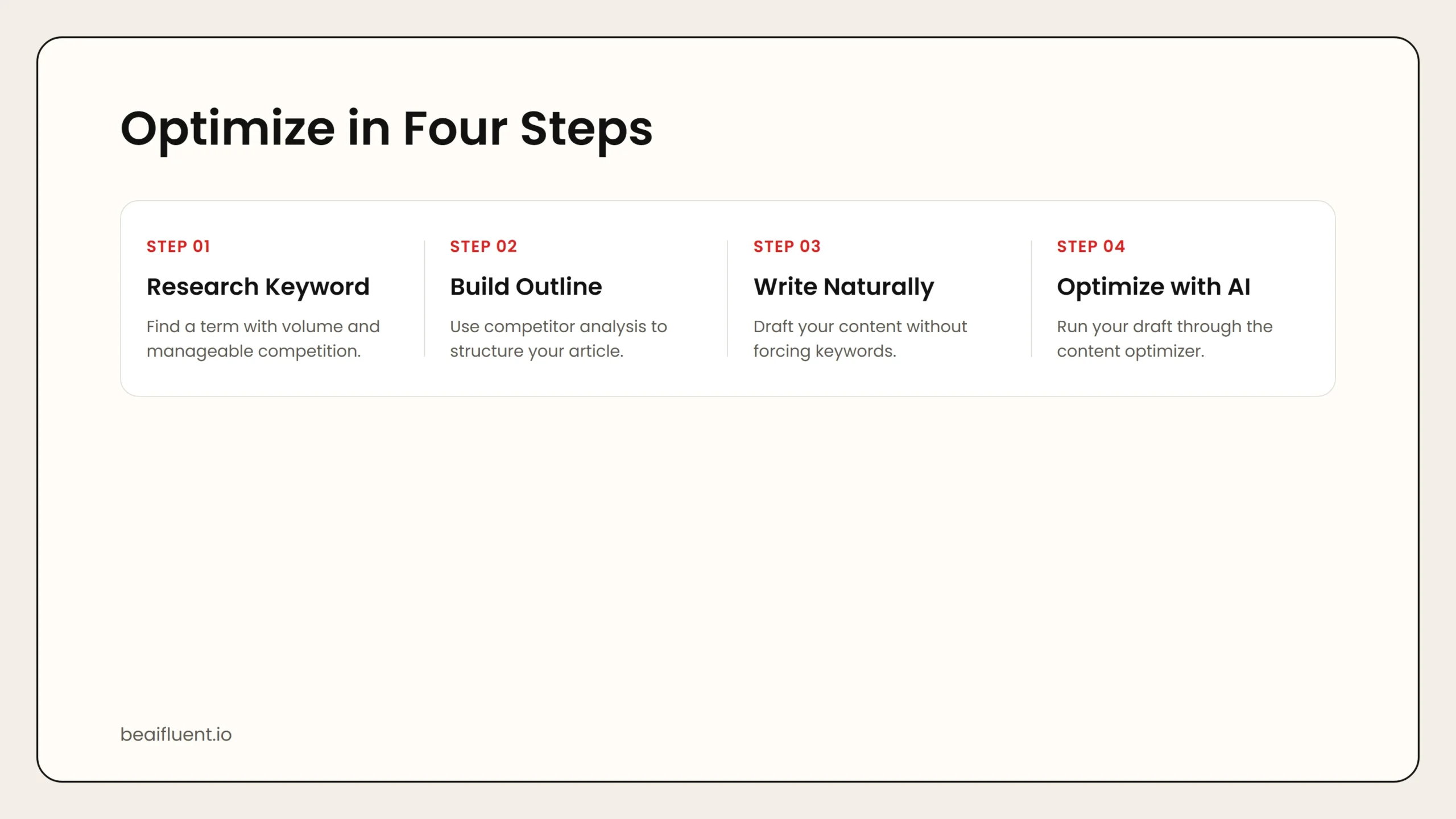 Caption: Research your keyword, build an outline from competitors, write naturally, then optimize with your AI SEO tool.
Common Mistakes to Avoid
Even the best AI SEO tool can hurt your rankings if you misuse it. Here are the most common traps:
- Keyword stuffing. Some creators add every suggested term until the article reads like robot spam. Google penalizes this. Use keywords naturally.
- Ignoring search intent. A tool might tell you to write 3,000 words, but if the top results are short product lists, a long essay will not rank.
- Over-optimizing. Chasing a perfect content score can drain personality from your writing. Readers notice. Google notices too.
- Skipping manual research. AI tools analyze competitors, but they cannot replace original research, expert interviews, or unique data.
Frequently Asked Questions
Can AI SEO tools guarantee a first-page ranking?
No. They improve your chances by aligning your content with top-ranking pages. However, backlinks, domain authority, and user behavior also affect rankings.
Do I need an AI SEO tool if I use WordPress?
WordPress plugins like Yoast SEO handle basic on-page optimization. AI SEO tools go deeper by analyzing competitors and suggesting specific content improvements.
Are free AI SEO tools worth using?
Free trials are useful for testing. However, serious SEO requires paid tools. Free versions usually limit keyword data, competitor reports, or content scores.
Which AI SEO tool is best for beginners?
RankIQ is the most beginner-friendly. Surfer SEO is also accessible if you watch their tutorial videos. Clearscope is better for experienced teams.