
AI can write essays, answer questions, and summarize documents in seconds. However, it can also lie confidently. An AI hallucination is a false statement generated by an AI that sounds completely true. These errors are not bugs in the traditional sense. They are a side effect of how large language models work.
Understanding AI hallucinations matters because the mistakes are often subtle. A hallucination might be a fake statistic, a made-up study, or a completely invented historical event. If you do not know how to spot them, you risk spreading misinformation or making bad decisions.
This guide explains what AI hallucinations are, why they happen, and how to protect yourself.
What Is an AI Hallucination?
An AI hallucination happens when a language model generates information that is not grounded in reality. The output looks correct. It follows proper grammar, uses confident language, and may even include fake citations. However, the facts are wrong.
Here are common types of AI hallucinations:
- Invented facts. The AI creates a statistic, quote, or study that does not exist.
- False connections. The AI links two real events incorrectly, creating a narrative that never happened.
- Outdated truths. The AI presents old information as current, ignoring recent changes.
- Source confusion. The AI attributes a real quote to the wrong person or organization.
For example, if you ask an AI for a legal precedent, it might describe a real-sounding court case that never occurred. The case name, date, and ruling all sound plausible. None of them are true.
Why Do AI Models Hallucinate?
AI models like ChatGPT, Claude, and Gemini do not know facts the way humans do. They predict the next word in a sentence based on patterns in their training data. Therefore, their goal is to produce coherent text, not necessarily accurate text.
Here are the main reasons hallucinations happen:
- Pattern completion over truth. The model chooses words that fit the pattern, even if the pattern leads to a false conclusion.
- Training data gaps. If the training data lacks information on a niche topic, the model fills the gap with plausible-sounding guesses.
- Over-optimization for helpfulness. Models are tuned to give useful answers. Sometimes that means inventing details rather than admitting ignorance.
- Prompt pressure. When a user insists on an answer, the model may comply with a fabricated response instead of saying it does not know.
Importantly, hallucinations are not malicious. The AI is not trying to deceive you. It is simply doing what it was trained to do: generate coherent language.
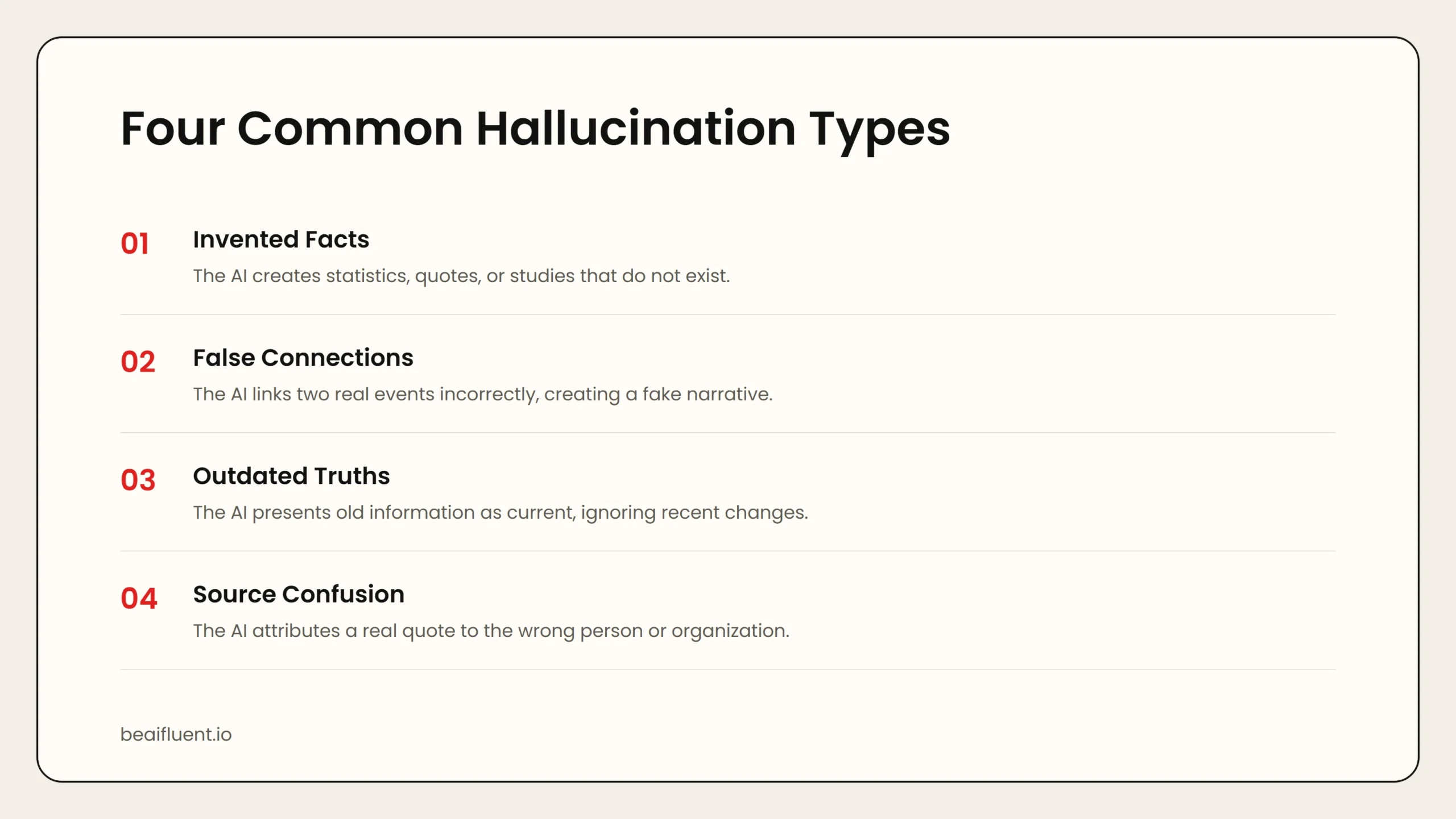
Caption: AI hallucinations take four common forms: invented facts, false connections, outdated truths, and source confusion.
Real Examples of AI Hallucinations
Hallucinations happen across every major AI platform. Here are documented examples:
- Legal research. A lawyer used ChatGPT to find precedents for a court filing. The AI cited multiple cases that did not exist. The lawyer submitted the filing and faced sanctions when the court discovered the fake citations.
- Medical advice. A user asked an AI about drug interactions. The AI recommended a combination that was potentially dangerous. The recommendation sounded authoritative but was not based on real medical literature.
- Historical events. A user asked about a historical figure. The AI invented a detailed biography, including awards and publications that never existed.
- News summaries. An AI summarized a breaking news story and included details from an unrelated event. The summary read smoothly but mixed up key facts.
These examples show that hallucinations are not rare edge cases. They happen regularly, especially in specialized domains like law, medicine, and academia.
How to Spot AI Hallucinations
Spotting hallucinations requires a healthy skepticism and a simple verification workflow. Here are the most reliable techniques:
1. Check for specific citations
If the AI provides a statistic, quote, or study, ask for the source. Then verify that source independently. Do not trust the citation unless you can find it yourself.
2. Look for vague language
Hallucinations often hide behind vague phrasing like “studies show” or “many experts believe” without naming the studies or experts. Specific claims are easier to verify than general ones.
3. Cross-reference with trusted sources
Copy the key claim into a search engine. If reliable sources confirm it, the claim is likely true. If no reputable source mentions it, the AI may have invented it.
4. Test with a rephrase
Ask the same question in a different way. If the AI gives contradictory answers, at least one response is likely a hallucination.
5. Be extra careful with niche topics
Hallucinations are more common in specialized fields like law, medicine, and advanced science. The training data is thinner in these areas, so the model guesses more often.
6. Ask the AI to admit uncertainty
You can prompt the AI to flag uncertain information. For example, add this to your prompt: “If you are unsure about any fact, say so instead of guessing.” This does not eliminate hallucinations, but it reduces them.
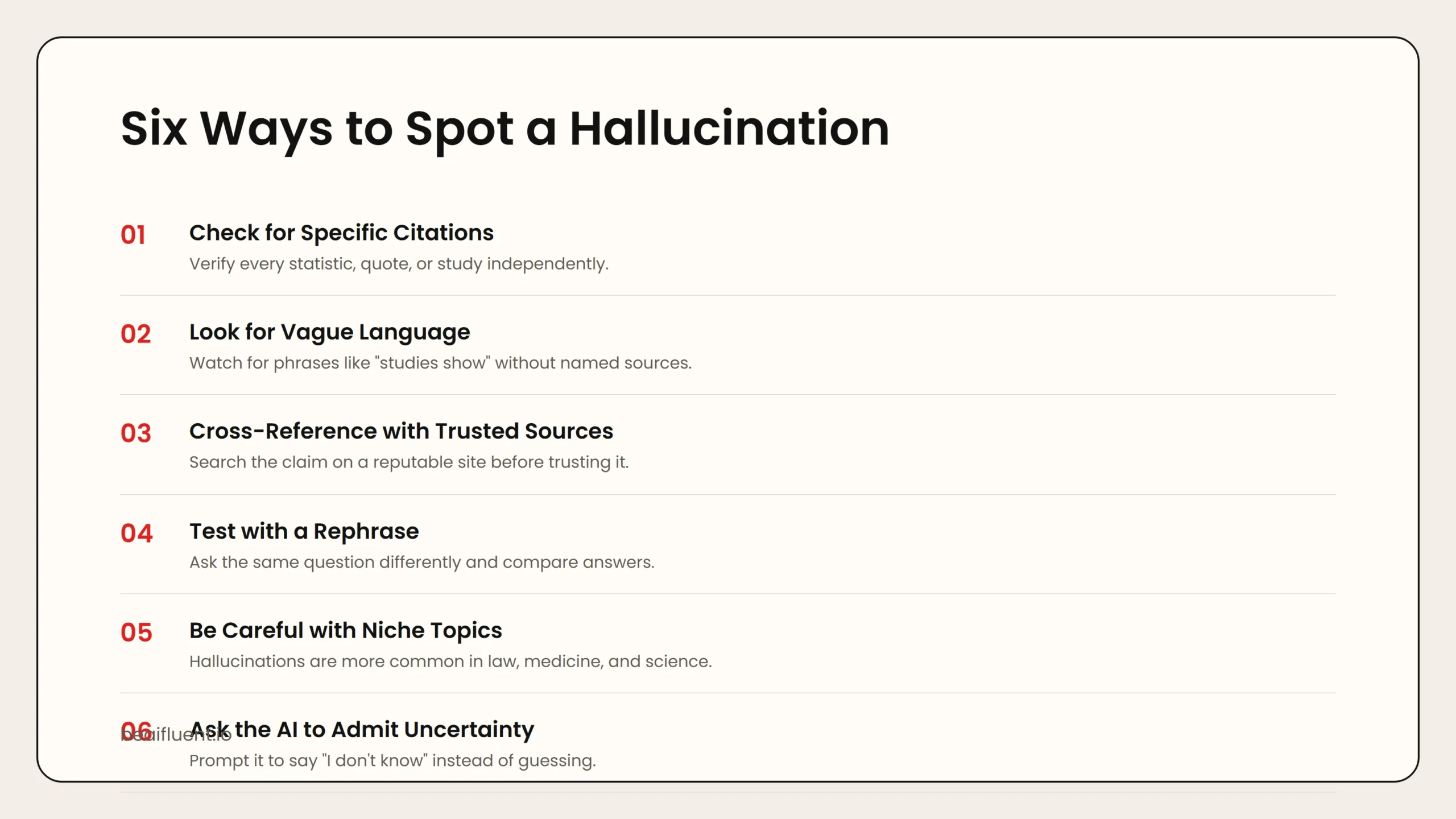
Caption: Check citations, watch for vague language, cross-reference sources, rephrase the question, be careful with niche topics, and ask the AI to admit uncertainty.
How to Reduce Hallucinations in Your Workflow
You cannot eliminate hallucinations entirely, but you can minimize their impact. Follow this three-step safety workflow:
- Treat AI output as a first draft, not a final source. Use AI for brainstorming, summarizing, and outlining. Do not use it as a primary source for facts.
- Verify every critical claim. If a decision depends on the information, confirm it with an independent source.
- Keep a human in the loop. For high-stakes work like legal filings, medical decisions, or academic publishing, always have an expert review AI-generated content.
If you want a broader framework for verifying AI output, read our guide on are AI tools accurate. It covers realistic expectations and a practical fact-checking workflow.
Do All AI Models Hallucinate Equally?
No. Different models have different hallucination rates.
- ChatGPT: Hallucinates less on general knowledge but can invent sources when browsing is enabled. The latest GPT-4o model is more accurate than earlier versions.
- Claude: Tends to be more cautious. It often says “I don’t know” rather than guessing. However, it still hallucinates on niche topics.
- Gemini: Benefits from live web search, which reduces outdated hallucinations. However, it sometimes overstates confidence in weak sources.
No model is immune. The safest approach is to verify all AI output, regardless of which tool you use.
Common Myths About AI Hallucinations
Myth: AI only hallucinates on complex topics.
Fact: AI can hallucinate on simple topics too. It might invent a historical date, misquote a famous person, or get a basic math problem wrong.
Myth: Paid AI plans never hallucinate.
Fact: Paid tiers use the same underlying technology. They hallucinate less often because the models are larger, but they are not perfect.
Myth: You can eliminate hallucinations with better prompts.
Fact: Better prompts reduce hallucinations, but they cannot remove them entirely. Verification is still essential.
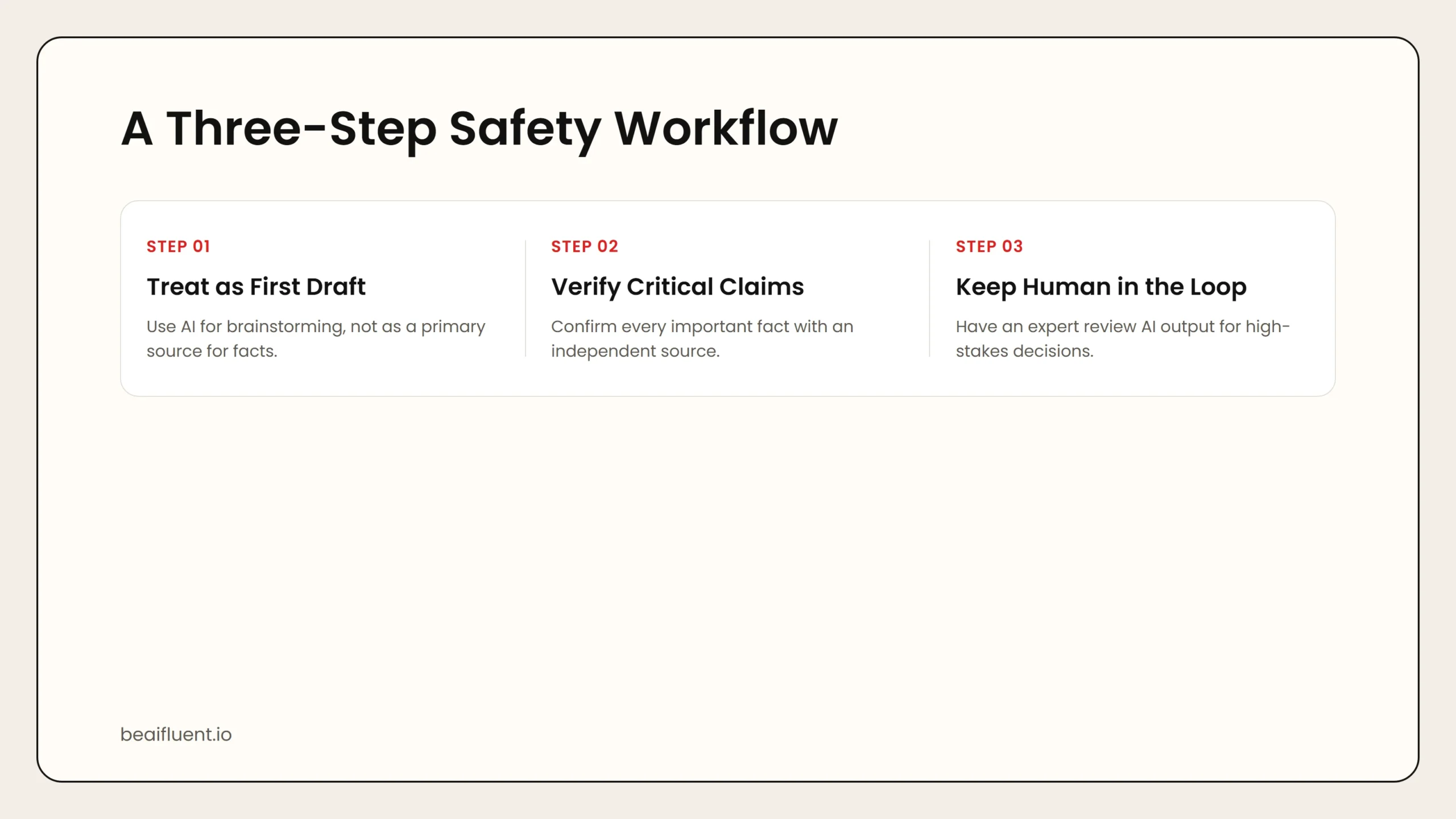
Caption: Treat AI as a first draft, verify every critical claim, and keep a human in the loop for high-stakes work.
A Simple Fact-Checking Checklist
Before you trust any AI-generated claim, run through this checklist:
- [ ] Can I find the claim on a reputable website?
- [ ] Does the AI provide a specific, verifiable source?
- [ ] Have I asked the same question twice and received the same answer?
- [ ] Is this topic within the AI’s training data timeframe?
- [ ] Would a human expert agree with this claim?
If you answer no to any of these questions, treat the claim as unverified.
Frequently Asked Questions
What is the simplest definition of an AI hallucination?
An AI hallucination is when an AI makes up information that sounds true but is not.
Can AI hallucinations be dangerous?
Yes. In fields like law, medicine, and finance, acting on false AI output can cause real harm. Always verify AI-generated advice with a qualified professional.
Why does AI sound so confident when it is wrong?
AI models are trained to produce coherent, fluent text. Confidence is a byproduct of fluent language generation, not actual certainty.
Which AI hallucinates the least?
Current benchmarks suggest Claude is the most cautious, while Gemini benefits from live search. However, all major models hallucinate sometimes. Verification matters more than model choice.