
HR teams are pulled in three directions at once. Recruiters need to fill roles faster without sacrificing quality. Onboarding specialists must get new hires productive quickly. Engagement managers want to spot retention risks before top performers hand in notice. The best AI tools for HR in 2026 help with all three jobs by automating repetitive work and surfacing insights that humans would otherwise miss.
In this guide, we compare the top AI HR tools across recruiting, onboarding, and engagement. Every platform on this list is used by real HR teams today, with verified pricing and honest limitations.
Key Takeaways
- Workable leads on AI-powered recruiting for mid-market teams with transparent pricing.
- BambooHR is the best all-in-one platform for small and mid-size businesses.
- Lattice excels at performance management, engagement surveys, and retention analytics.
- Eightfold AI dominates talent intelligence and internal mobility for large enterprises.
- HireVue is the standard for structured, AI-assisted video interviewing at scale.
What to Look for in an AI HR Tool
Before choosing a platform, identify your team’s biggest pain point. Some HR teams drown in unqualified applicants. Others lose new hires within 90 days because onboarding is disorganized. Some struggle to measure engagement until it is too late.
Here are the features that matter most:
- AI sourcing and screening. The tool should find candidates across job boards, rank them by fit, and reduce unconscious bias in initial screening.
- Structured interviewing. It should standardize evaluation criteria so every candidate is judged against the same competencies.
- Onboarding automation. It should guide new hires through paperwork, training, and introductions without HR chasing status updates.
- Engagement analytics. It should analyze survey sentiment, flag burnout risks, and connect engagement data to retention outcomes.
- Compliance and security. Look for SOC 2 certification, GDPR compliance, and bias audit features. The EU AI Act classifies hiring AI as high-risk.
Additionally, consider headcount. A 50-person company needs different tools than a 5,000-person enterprise. All-in-one platforms work well for smaller teams. Large organizations usually need best-of-breed point solutions.
Warning: AI hiring tools can inherit biases from training data. Regular audits of screening outcomes are essential. Several US states now require employers to disclose when AI is used in hiring decisions.
The Top 5 AI HR Tools Compared
1. Workable — Best AI-Powered Recruiting for Mid-Market
Workable combines a full applicant tracking system with genuinely useful AI features. Its AI sources candidates from over 400 job boards, generates job descriptions, ranks applicants by fit, and even provides an Interview Copilot that eliminates post-interview admin.
Why it stands out:
- AI-powered candidate sourcing across 400+ boards and 400 million+ profiles.
- One-click job posting to multiple platforms simultaneously.
- Structured interview kits and scorecards for consistent evaluation.
- Video interview capabilities built into the platform.
- Career page builder with AI-assisted copy.
Pricing: Starter at $149 per month for up to 50 employees. Standard at $360 per month. Premier at $599 per month. All plans include a 15-day free trial.
Best for: Growing companies with 50 to 1,000 employees that want powerful recruiting without enterprise pricing or implementation cycles.
Privacy note: Workable processes candidate data including resumes and interview recordings. Confirm your data retention and deletion policies align with regional privacy laws.
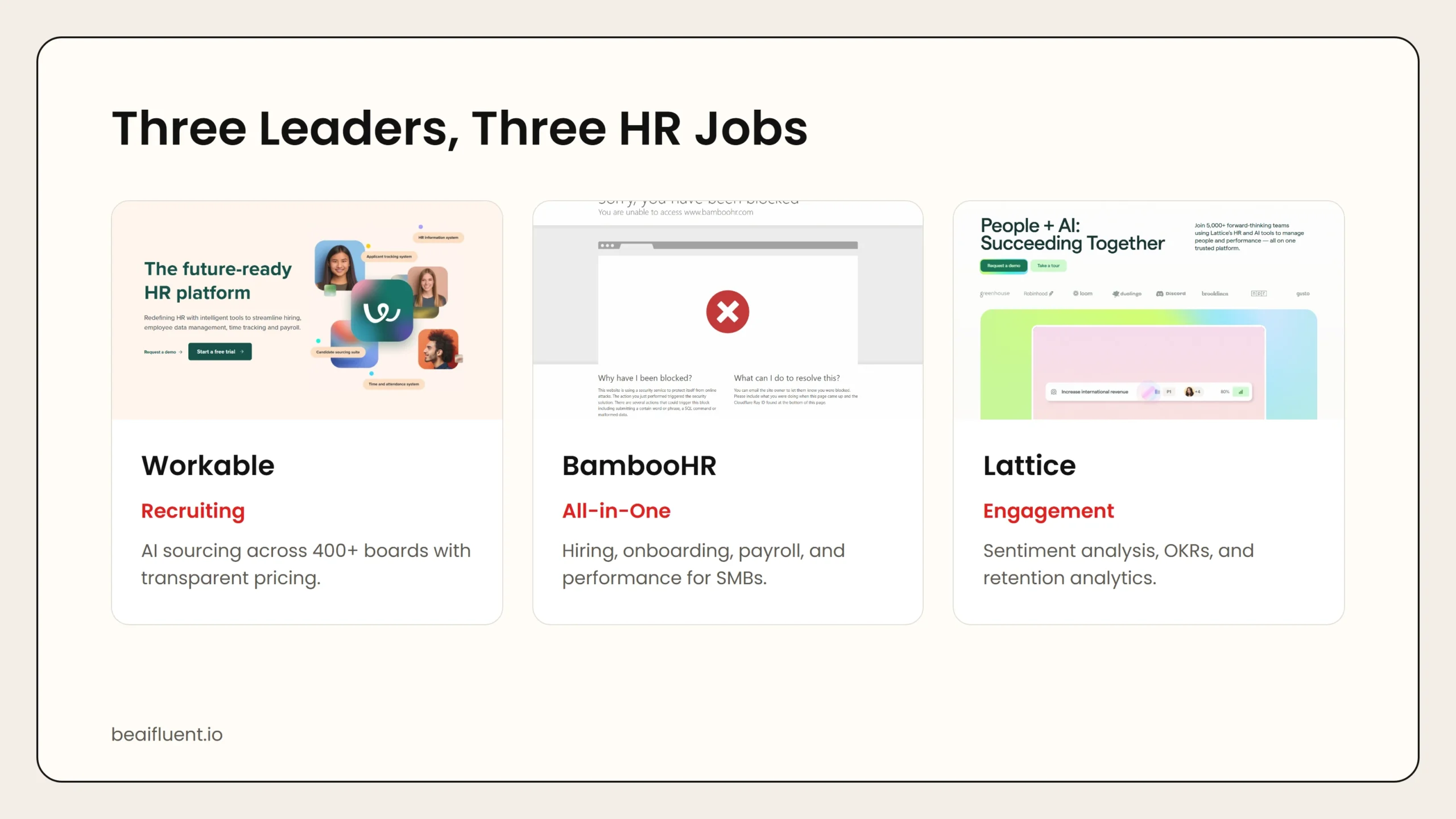 Caption: Workable leads on mid-market recruiting. BambooHR wins as an all-in-one SMB platform. Lattice dominates performance management and engagement analytics.
2. BambooHR — Best All-in-One for Small and Mid-Size Teams
BambooHR is not the flashiest AI tool on the market, but it is the most practical choice for companies that need one platform covering the full employee lifecycle. Hiring, onboarding, time tracking, payroll, and performance management all live in one clean interface.
Why it stands out:
- AI-assisted hiring workflows with built-in applicant tracking.
- Automated onboarding with customizable task lists and reminders.
- Employee self-service portal reduces HR administrative load.
- Performance reviews and eNPS tracking with AI-generated insights.
- Built-in payroll for US-based teams.
Pricing: Core plan starts at approximately $10 per employee per month. Pro plan starts at approximately $17 per employee per month. Payroll, time tracking, and benefits are add-ons.
Best for: Companies with 25 to 500 employees that want one HR platform instead of five separate tools.
Privacy note: BambooHR stores employee personal data including SSNs, salaries, and performance records. Verify their SOC 2 compliance and data encryption standards meet your requirements.
3. Lattice — Best for Performance Management and Engagement
Lattice connects the dots between goals, performance reviews, engagement surveys, and compensation. Its AI analyzes engagement survey results to surface actionable insights, identifying teams at risk of burnout or disengagement before turnover spikes.
Why it stands out:
- AI-powered engagement surveys with sentiment analysis.
- OKR and goal tracking linked to performance conversations.
- Continuous performance reviews instead of annual-only cycles.
- Compensation benchmarking and planning tools.
- 44% of HR teams now use AI tools specifically for engagement and retention.
Pricing: Starts at $11 per person per month for the engagement module. Performance management, OKRs, and compensation are additional modules.
Best for: Mid-market companies with 100 to 2,000 employees that want to build a data-driven performance and engagement culture.
Privacy note: Lattice processes engagement sentiment and performance ratings. Ensure employees understand how their feedback data is used and aggregated.
4. Eightfold AI — Best for Talent Intelligence and Internal Mobility
Eightfold AI takes a different approach from traditional ATS platforms. Instead of matching keywords, its deep learning models analyze skills, potential, and career trajectory to match people to opportunities. It is particularly strong at surfacing internal candidates for open roles before going external.
Why it stands out:
- Skills-based talent matching across internal and external candidates.
- Career pathing tools that help employees see growth options inside the company.
- Diversity and inclusion analytics that reduce reliance on educational pedigree.
- Workforce planning with predictive attrition modeling.
- Recognized as a Leader in the 2025 IDC MarketScape for Talent Intelligence.
Pricing: Custom enterprise pricing based on employee count. No public pricing listed.
Best for: Enterprise companies with 1,000+ employees focused on skills-based hiring, internal mobility, and long-term workforce planning.
Privacy note: Eightfold AI builds profiles from work history and labor market signals. Confirm your employees have consented to AI-driven talent profiling and that you can explain how matching recommendations are generated.
5. HireVue — Best for Structured Video Interviewing
HireVue specializes in one thing and does it better than anyone else: AI-assisted video interviews at scale. The platform uses structured, validated assessments to evaluate candidates through video responses, analyzed against job-relevant competencies.
Why it stands out:
- On-demand video interviews candidates can complete on their own schedule.
- AI scoring based on validated industrial-organizational psychology models.
- Game-based assessments for cognitive ability testing.
- Integration with major ATS platforms including Greenhouse, Lever, and Workable.
- Companies using structured AI-supported interviews see 24–30% higher assessment consistency.
Pricing: Custom pricing based on hiring volume. Typically suited for mid-market to enterprise companies.
Best for: High-volume hiring environments such as retail, hospitality, and campus recruiting where screening hundreds or thousands of candidates manually is not feasible.
Privacy note: HireVue records and analyzes video interviews. Inform candidates about AI evaluation before they participate, and ensure compliance with regional AI hiring disclosure laws.
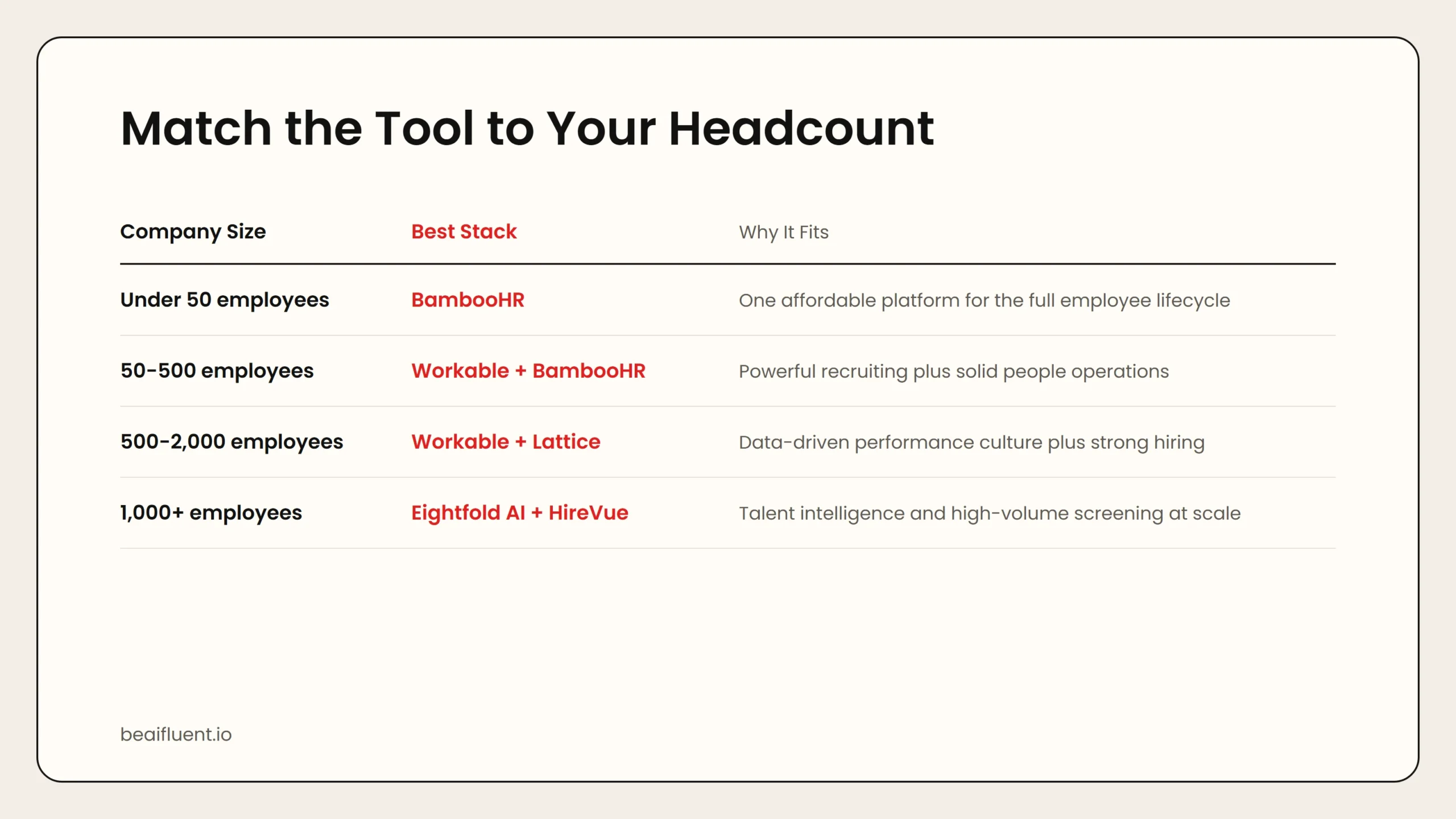 Caption: Startups use BambooHR. Growing companies add Workable. Mid-market teams layer Lattice. Enterprises evaluate Eightfold AI and HireVue.
Side-by-Side Comparison
| Tool | Starting Price | Best For | Core Strength | Free Trial |
|---|---|---|---|---|
| Workable | $149/mo | Mid-market recruiting | 400+ job board sourcing | 15-day trial |
| BambooHR | ~$10/employee/mo | SMB all-in-one HR | Full employee lifecycle | Demo available |
| Lattice | $11/person/mo | Performance + engagement | Sentiment analysis + OKRs | Demo available |
| Eightfold AI | Custom enterprise | Talent intelligence | Skills-based matching | Demo available |
| HireVue | Custom | High-volume interviewing | Structured video assessment | Demo available |
Use this table to match your team size and budget to the right starting point. Small teams should begin with BambooHR. Growing teams should add Workable for recruiting. Enterprises should evaluate Eightfold AI for talent strategy.
How to Choose the Right Tool for Your Team
Different organizations need different HR AI support. Here is a practical matching guide:
- Startup under 50 employees → BambooHR covers hiring, onboarding, and core people ops in one affordable platform.
- Growing company with hiring bottlenecks → Workable for AI recruiting, paired with BambooHR for people operations.
- Mid-market company with retention concerns → Lattice for engagement and performance, Workable for recruiting.
- Enterprise with 1,000+ employees → Eightfold AI for talent intelligence, HireVue for high-volume screening, Workday or SAP for core HRIS.
- High-volume seasonal hiring → HireVue for structured video screening, Workable for sourcing and ATS.
Tip: Do not try to overhaul your entire HR tech stack at once. Start with the function losing the most time, pilot one tool for 60 days, measure outcomes, then expand.
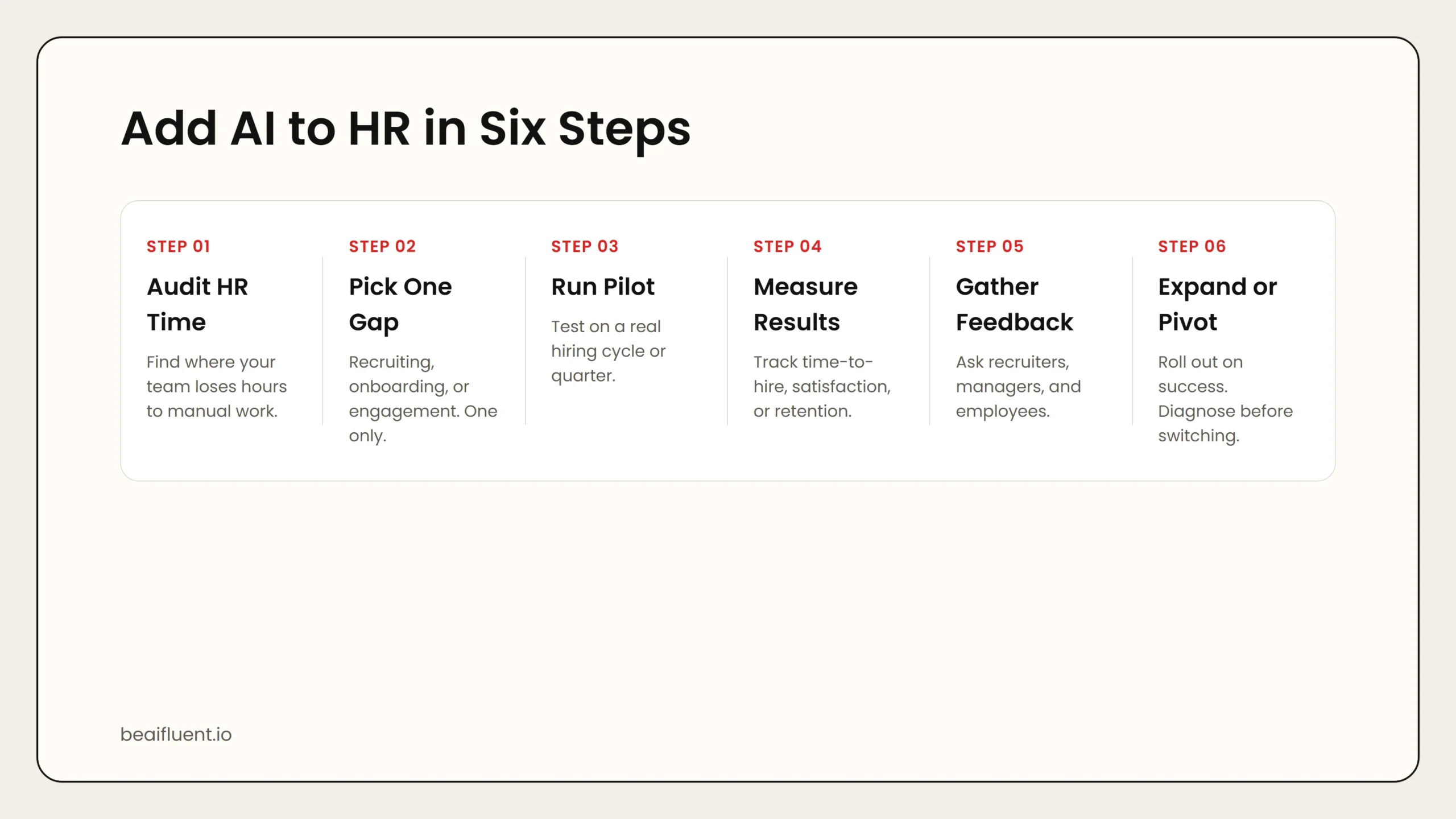 Caption: Audit HR time, pick one gap, run a pilot, measure results, gather feedback, then expand or pivot.
A Simple Workflow for Adding AI to HR
Follow these steps to introduce AI HR tools without disrupting your team:
- Audit your current process. Track where your HR team spends the most manual hours. Common culprits are resume screening, interview scheduling, onboarding checklists, and engagement survey analysis.
- Pick one bottleneck. Choose the single biggest time sink and match it to one tool from this guide.
- Run a pilot hiring cycle or quarter. Test the tool on real work but with a smaller group before company-wide rollout.
- Measure outcomes. Track metrics like time-to-hire, offer acceptance rate, new-hire satisfaction, or engagement scores.
- Gather feedback. Ask recruiters, hiring managers, and employees what worked and what frustrated them.
- Roll out or pivot. If the pilot succeeds, expand access. If not, diagnose why before trying a different tool.
Warning: AI hiring tools must not discriminate based on protected characteristics under EEOC rules. No AI system is bias-free. Regular audits of screening outcomes are essential, and you should be able to explain why the AI made specific recommendations.
Common Mistakes to Avoid
Even well-intentioned HR teams make errors when adopting AI. Avoid these pitfalls:
- Buying based on brand alone. The most famous tool may not fit your headcount or workflow. Match the tool to your actual pain point.
- Ignoring the employee experience. A clunky onboarding portal creates a poor first impression. Choose tools candidates and employees will actually enjoy using.
- Skipping compliance review. Hiring AI is regulated in the EU and increasingly in US states. Verify disclosure requirements and bias audit obligations before launch.
- Over-automating human moments. A rejection email sent by AI without human review feels cold. Preserve human touch in high-emotion interactions.
- Failing to train managers. Hiring managers need guidance on how to interpret AI scores and when to override them. Unsupervised use creates liability.
Frequently Asked Questions
Can AI replace HR professionals?
No. AI automates repetitive tasks like resume screening, scheduling, and survey analysis. However, strategic decisions, employee relationships, conflict resolution, and empathy-driven conversations still require human judgment. SHRM’s 2026 report found that AI is 5.7 times more likely to shift job responsibilities than eliminate positions.
Is AI in hiring biased?
AI can inherit biases from training data. That is why explainability and regular audits matter. The EU AI Act classifies hiring AI as high-risk and requires transparency and fairness. Look for tools that let you audit scoring criteria and provide bias detection features.
How much do AI HR tools cost?
Costs range from $10 per employee per month for BambooHR to custom enterprise pricing for Eightfold AI. Mid-market recruiting tools like Workable start at $149 per month. Engagement platforms like Lattice start at $11 per person per month.
What is the ROI of AI tools for HR?
Companies using AI in HR report up to 40% cost reduction in HR processes and 25–35% higher first-year retention rates when using AI-assisted matching. The top metrics for measuring ROI are productivity gains, cost savings, improved decision-making, and employee satisfaction.
Do I need to disclose AI use to candidates?
Yes, in many jurisdictions. Several US states now require employers to disclose when AI is used in hiring decisions. The EU AI Act mandates transparency for high-risk AI systems including hiring tools. Always inform candidates before AI evaluates their application or interview.
Sources
- Workable pricing and features
- BambooHR pricing and features
- Lattice pricing and features
- Eightfold AI official site
- HireVue official site
- SHRM 2026 AI in HR report
- EU AI Act high-risk systems guidance
If you are building AI fluency across your organization, our guide on how to teach your team AI fluency can help with responsible rollout. For educators exploring AI in talent development, see our article on AI tools for teachers.