
AI Literacy vs AI Fluency: What Is the Difference?
AI literacy and AI fluency are often used as if they mean the same thing. They do not. AI literacy means understanding what AI is and what it can do. AI fluency means being able to use AI tools effectively to get real work done.
The difference matters because most advice about “learning AI” stops at literacy. It teaches you concepts and vocabulary, but it does not teach you how to actually use the tools well enough to trust the results. Fluency is where the practical value starts.
This article explains what each term means, how they differ across specific dimensions, and how to move from one level to the next.
Key Takeaways
- AI literacy is understanding what AI can do. AI fluency is being able to use it well.
- Literacy is the foundation. Fluency is the applied skill built on top of it.
- Most people stop at literacy and wonder why AI does not feel useful yet.
- The gap between literacy and fluency is where most professionals get stuck.
- You do not need to master both separately. Fluency includes and extends literacy.
Table of Contents
- What Is AI Literacy?
- What Is AI Fluency?
- AI Literacy vs AI Fluency: The Core Differences
- Why the Distinction Matters
- What Each Level Looks Like in Practice
- Which One Should You Focus On?
- How to Move From Literacy to Fluency
- FAQ
What Is AI Literacy?
AI literacy is the ability to understand what artificial intelligence is, how it works at a high level, and what it can and cannot do. It is the conceptual foundation that lets you make sense of AI as a technology.
A person with AI literacy can:
- Explain what a large language model does in plain language
- Understand why AI tools sometimes produce incorrect or fabricated information
- Recognize when a product or service is using AI
- Describe the basic difference between generative AI and traditional software
- Understand common concerns about AI, including bias, privacy, and job displacement
AI literacy is important. Without it, you cannot have an informed opinion about AI, evaluate claims about what it can do, or make reasonable decisions about when and where to use it.
But literacy by itself does not produce output. Knowing that AI tools can hallucinate does not mean you know how to check whether a specific claim is accurate. Understanding that prompts matter does not mean you know how to write a good one. AI literacy gives you the map. It does not teach you how to drive.
What Is AI Fluency?
AI fluency is the ability to use AI tools effectively in your own work. It goes beyond understanding concepts and into applying skills. A person who is AI fluent can sit down with a tool like ChatGPT, Claude, or Gemini and produce a result they can trust — not because they followed a recipe, but because they understand how to shape the interaction, evaluate the output, and integrate it into a real workflow.
AI fluency includes five core skills:
- Prompting — writing clear, specific instructions that produce useful output
- Output evaluation — reviewing AI-generated content for accuracy, quality, and completeness
- Tool awareness — knowing which tools exist, what each does well, and when to switch
- Workflow integration — fitting AI into repeatable work processes
- Responsible use — understanding the ethical, privacy, and quality boundaries of AI tools
These skills are not theoretical. They are practiced. You build fluency the same way you build fluency in a language: by using it regularly, noticing what works and what does not, and improving over time.
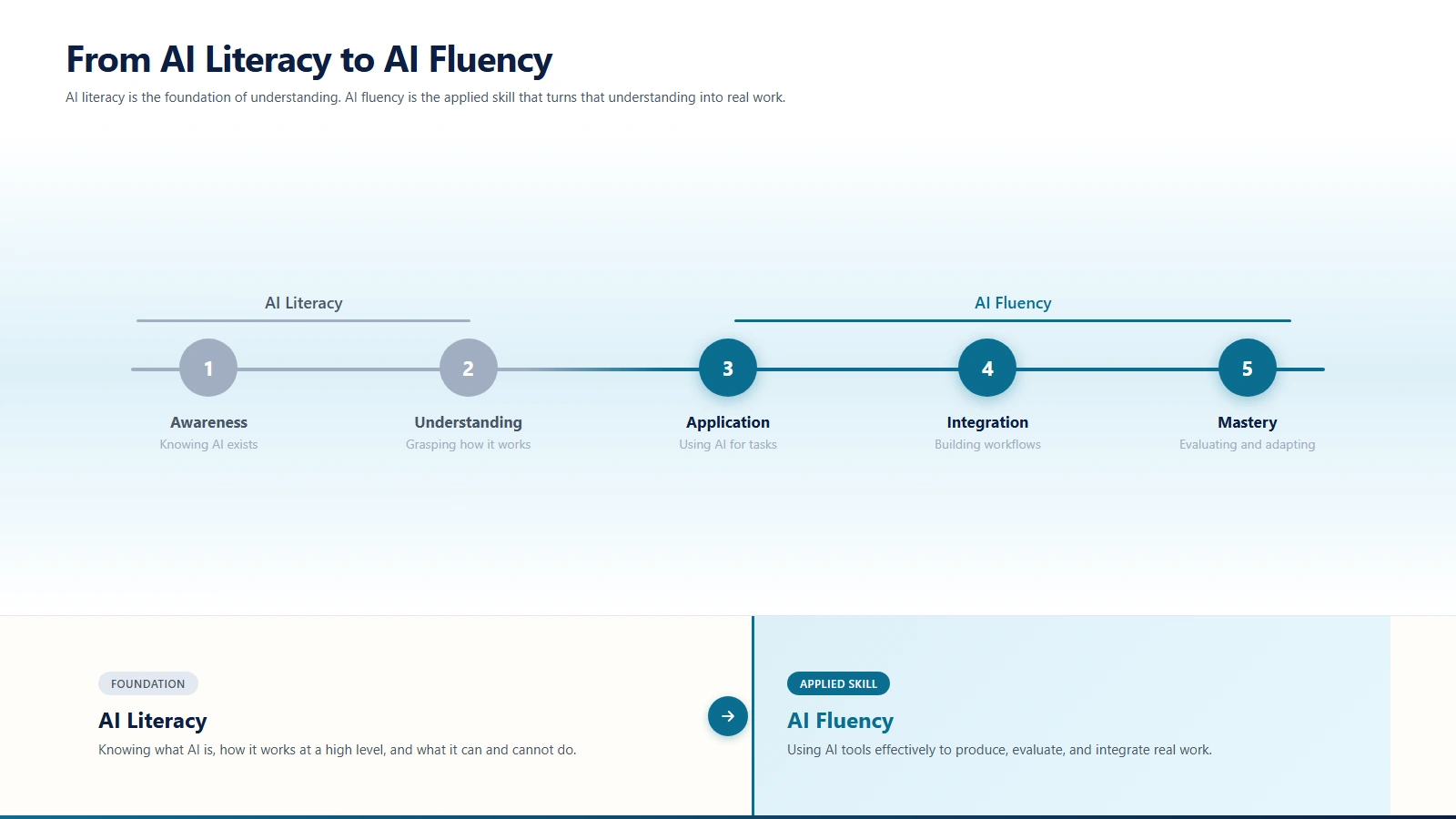
Caption: AI literacy is the foundation of understanding. AI fluency is the applied skill that turns that understanding into real work.
AI Literacy vs AI Fluency: The Core Differences
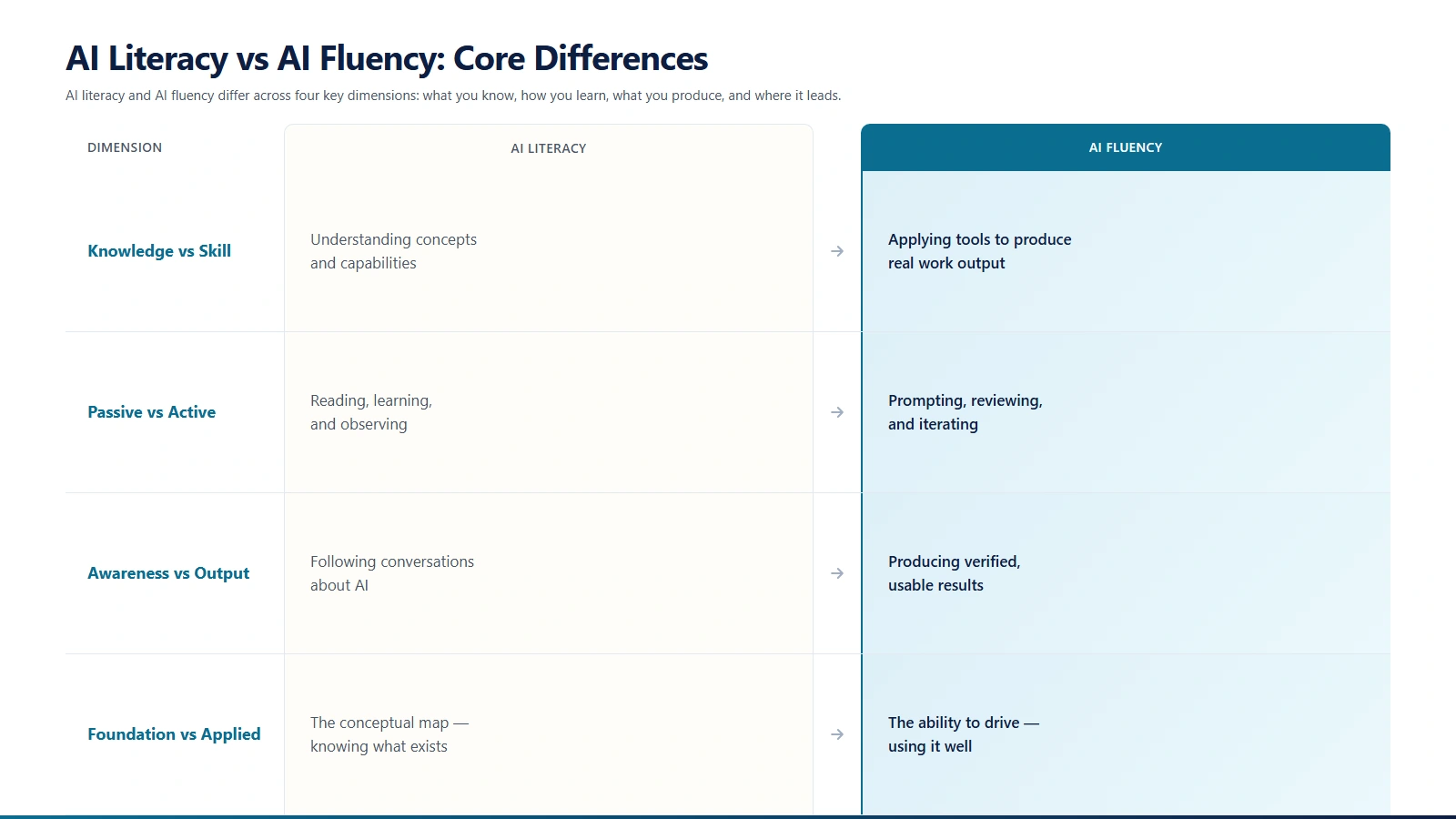
Caption: AI literacy and AI fluency differ across four key dimensions: what you know, how you learn, what you produce, and where it leads.
The distinction between AI literacy and AI fluency shows up across several dimensions. Here is how they compare.
Knowledge vs Skill
AI literacy is knowledge-based. It answers the question: “Do you understand what AI is and what it can do?” AI fluency is skill-based. It answers a harder question: “Can you use AI tools to produce work you would trust and share?”
A person can score well on an AI literacy quiz without ever having opened an AI tool. A person with AI fluency has used the tools enough to know their strengths, their failure modes, and their limits from direct experience.
Passive vs Active
AI literacy is largely passive. You acquire it by reading, watching, and learning about AI. AI fluency is active. You build it by using AI tools, evaluating results, adjusting your approach, and repeating the process.
This is why many professionals feel informed about AI but still struggle to get useful results. They have invested in literacy but have not yet crossed into fluency.
Awareness vs Output
AI literacy produces awareness. You can follow a conversation about AI, understand the risks, and evaluate marketing claims. AI fluency produces output. You can draft a document, verify a research summary, build a workflow, or choose the right tool for a specific task — and do it well enough that the result is useful without heavy revision.
Foundation vs Applied Layer
AI literacy is the foundation. AI fluency is the applied layer built on top of it. You cannot be fluent without some literacy, but you can be literate without being fluent. Most people are in the second category — they understand AI in the abstract but have not developed the practical skills to use it well.
Think of it like cooking. Reading a cookbook gives you food literacy. You understand ingredients, techniques, and why recipes work. But you cannot feed anyone until you can actually cook. Fluency is cooking.
Why the Distinction Matters
The AI literacy vs AI fluency distinction matters because most professional development and workplace training stops at literacy.
Organizations run workshops that explain what generative AI is. Universities add modules about how language models work. Employees read articles about AI trends. All of this builds literacy. None of it builds fluency.
The result is a growing population of professionals who are AI-literate but not AI-fluent. They know enough to be curious but not enough to be effective. They try an AI tool once, get a mediocre result, and conclude that AI is overhyped. The problem was not the tool. It was the skill gap between knowing about AI and knowing how to use it.
This gap has real career consequences. According to a 2024 Microsoft and LinkedIn Work Trend Index report, 66% of leaders said they would not hire someone who lacked AI skills. They are not talking about literacy — understanding what AI is. They are talking about fluency — the ability to use it productively.
The distinction also matters for how you invest your learning time. If you already have a reasonable understanding of what AI can do, spending more time reading about AI will not move you forward. What will move you forward is practice: using tools, evaluating results, and building workflows.
What Each Level Looks Like in Practice
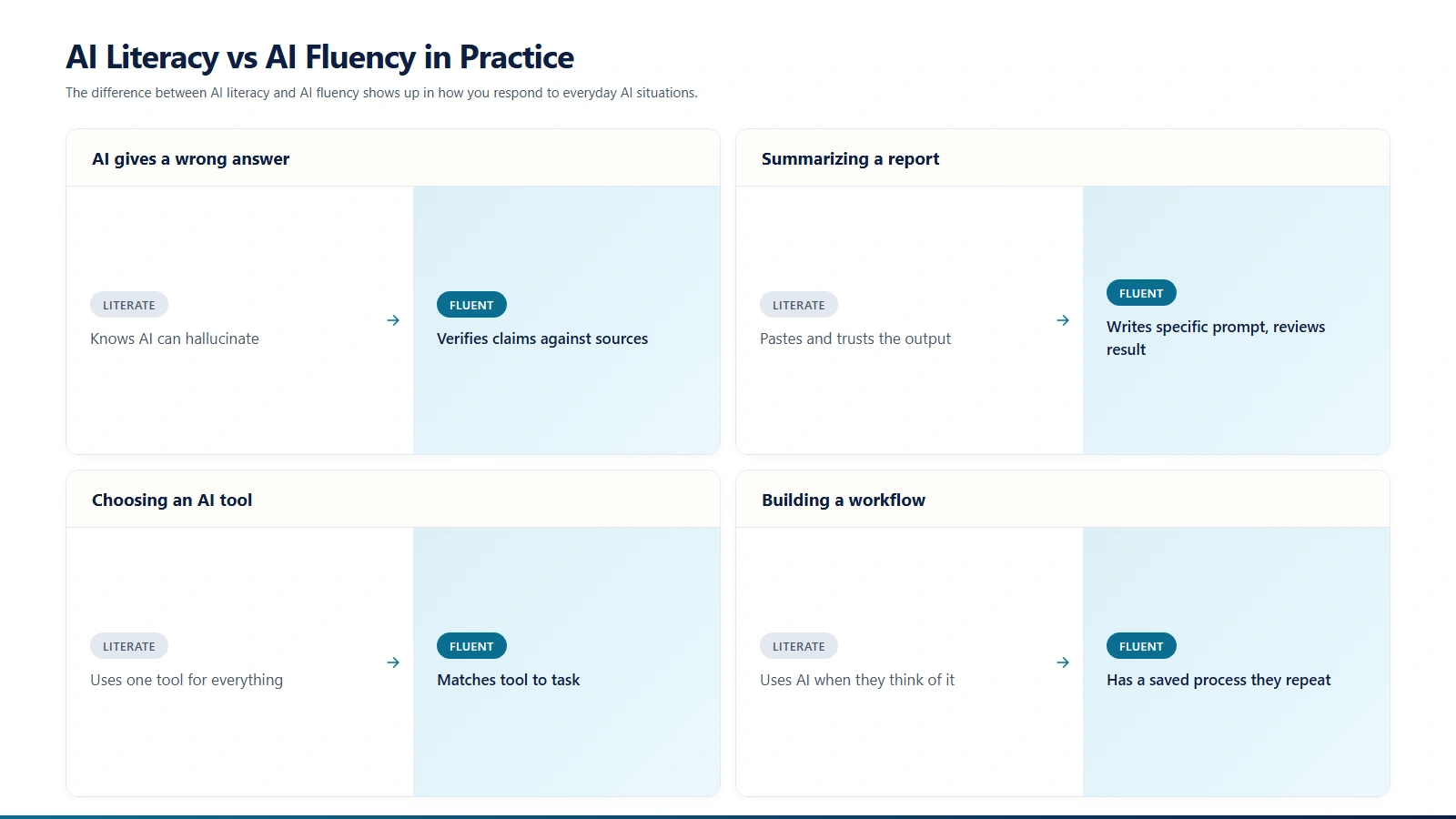
Caption: The difference between AI literacy and AI fluency shows up in how you respond to everyday AI situations.
The difference between AI literacy and AI fluency is easiest to see in real scenarios.
When AI gives a wrong answer
Literate response: “I know AI can hallucinate.” You understand the concept and can explain it to someone else. But you may not catch a specific hallucination in a piece of output because you have not practiced evaluating AI-generated content.
Fluent response: “This claim looks plausible but unsourced — let me check it against the original data before I use it.” You have a verification habit. You know where AI is most likely to fabricate, and you check those areas first.
When asked to summarize a report
Literate response: You paste the document into an AI tool, read the summary, and forward it. If the summary sounds reasonable, you trust it.
Fluent response: You paste the document, write a specific prompt that tells the tool what to focus on and what format to use, read the summary against the original, fix any errors or omissions, and then share it. You have a process, not just a single step.
When choosing an AI tool
Literate response: You use whatever tool you have heard of — probably ChatGPT — for every task, regardless of whether it is the best fit.
Fluent response: You know that different tools have different strengths. You might use Claude for long document analysis, ChatGPT for quick brainstorming, or a specialized CLI tool for coding tasks. You choose based on the task, not the brand.
When building a workflow
Literate response: You use AI occasionally when you think of it. There is no system. Each use starts from scratch.
Fluent response: You have a saved prompt template, a review checklist, and a clear sequence: generate, review, refine, use. You run this workflow weekly or daily. It is a repeatable process that gets faster over time.
Which One Should You Focus On?
If you are completely new to AI, start with literacy. You need enough conceptual grounding to understand what AI tools are, what they can and cannot do, and why output evaluation matters. Without that foundation, you will not know what to watch for when you start using the tools.
If you already have a basic understanding of AI — you know what a language model is, you know about hallucinations, you have read a few articles — stop investing in more literacy and start building fluency. The marginal return on more concept-reading is low. The return on practice is high.
Here is a simple test. If you can answer “yes” to most of these, you are already literate enough:
- I can explain what generative AI does in one sentence.
- I know that AI output can be wrong and why.
- I understand that different AI tools exist and serve different purposes.
- I know that how I write a prompt affects the quality of the output.
If you can answer those, you do not need more literacy. You need fluency. That means picking up a tool and using it for real work, then reviewing and improving your results.
How to Move From Literacy to Fluency
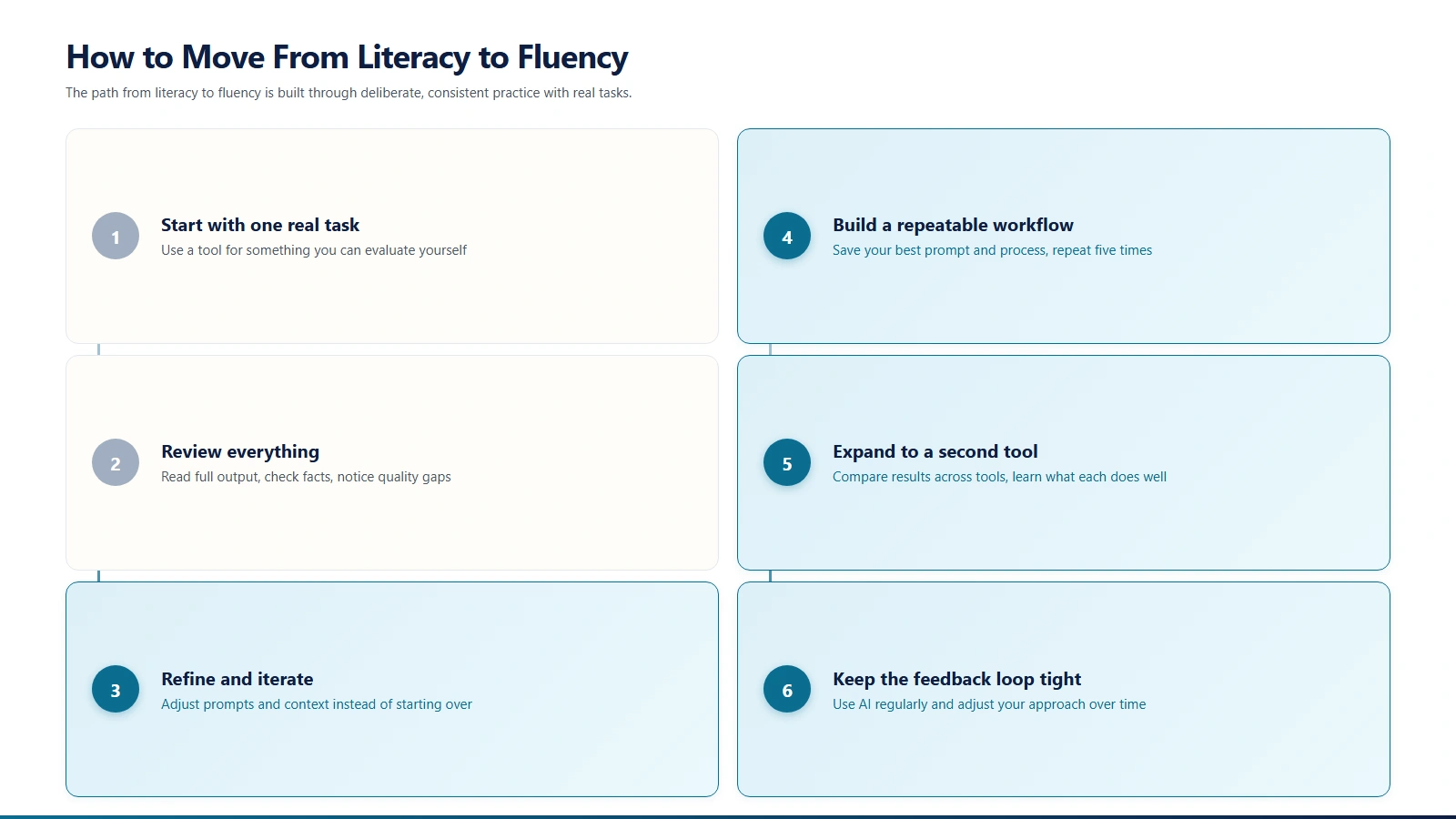
Caption: The path from literacy to fluency is built through deliberate, consistent practice with real tasks.
The path from AI literacy to AI fluency is not about learning more. It is about doing more — with intention.
Step 1. Start with one real task. Choose something you do at work that involves writing, summarizing, researching, or planning. Use an AI tool to help with it. Do not start with a high-stakes task. Start with one where you can easily evaluate the quality yourself.
Step 2. Review everything the tool produces. Do not accept AI output at face value. Read the full result. Check any factual claims. Notice where the tone is wrong, the structure is weak, or the content is vague. This review habit is the single most important skill that separates literate users from fluent ones.
Step 3. Refine and iterate. If the first result is not good, do not give up or start over. Adjust your prompt. Give the tool more context. Ask it to revise a specific section. The ability to iterate is what makes AI useful for real work instead of just demos.
Step 4. Build a repeatable workflow. Once you find a prompt and process that works, save it. Use it again the next time you do the same type of task. After five repetitions, you will have a stable workflow that saves you time consistently.
Step 5. Expand to a second tool or task. Once your first workflow is solid, try a different type of work or a different tool. Compare results. Learn what each tool does well. This builds the tool awareness dimension of fluency.
Step 6. Keep the feedback loop tight. Fluency grows when you use AI regularly, review the results honestly, and adjust your approach. Occasional use does not build skill. Weekly or daily practice does.
The transition does not take years. Most people can develop a functional level of AI fluency within 30 days of deliberate, consistent practice with real tasks.
FAQ
What is AI literacy in simple terms?
AI literacy is the ability to understand what artificial intelligence is, how it works at a high level, and what it can and cannot do. It is conceptual knowledge — the foundation you need before you can start using AI tools effectively.
What is the difference between AI literacy and AI fluency?
AI literacy is understanding AI as a concept. AI fluency is being able to use AI tools effectively for real work. Literacy is passive knowledge; fluency is active skill. You can be literate without being fluent, but you cannot be fluent without some literacy.
Do I need AI literacy before I can build AI fluency?
You need a basic level of AI literacy — enough to understand what the tools do, why output can be wrong, and why prompts matter. But you do not need to become an AI expert before you start practicing. Most people benefit from building literacy and fluency at the same time through hands-on use.
Is AI fluency more important than AI literacy?
They serve different purposes. AI literacy helps you understand. AI fluency helps you produce. For career purposes, fluency is increasingly what employers expect, because it translates into practical output. But literacy is the foundation that makes fluency possible.
How long does it take to go from AI literacy to AI fluency?
Most people can build a functional level of AI fluency within 30 days of regular, deliberate practice. The key is consistent use with real tasks, not passive reading or watching tutorials.
Conclusion
AI literacy vs AI fluency is not a competition between two skills. It is a progression. Literacy is where you start: understanding what AI is and what it can do. Fluency is where you arrive: being able to use AI tools effectively enough that they make a real difference in your work.
Most people today are literate but not fluent. They understand AI in the abstract but struggle to get consistently useful results from the tools. The gap between those two states is where the practical value lives — and where most professionals need to focus next.
If you already understand what AI can do, the next step is not more reading. It is practice. Pick one tool, one task, and one review step. Start building fluency today.
Suggested Internal Link Opportunities
- /blog/what-is-ai-fluency-and-why-it-matters (future — the cornerstone definition article)
- /blog/how-to-write-better-ai-prompts (future — prompting skills gateway)
- /blog/how-to-review-ai-output-before-you-trust-it (future — verification anchor)
- /blog/how-to-start-using-ai-as-a-complete-beginner (future — Day 1 companion)
- /blog/how-to-upskill-in-ai-without-burning-out (future — career readiness cluster)